My Indiana Writing Project colleague Kathy and I are pushing for a change. From all teachers!
With all the hoopla about the science of reading, by now, most teachers and administrators know that using explicit instruction is required for successful ELA skill development. In addition to reading with purposeful mini lessons, writing frequently with explicit instruction can build strong secondary writers, according to What Works Clearinghouse.
So as we think about the science of WRITING, we say this: replace your students’ writer’s notebooks with “Learner’s Notebooks.”

Huh? What’s the difference?
A writer’s notebook is specifically geared toward composition as the end result. Students practice writing, plan writing, and write drafts for more writing. They create plot maps and outlines and graphic organizers. They make heart maps and neighborhood maps- all terrific writing strategies. But even if students are taking notes about organizational strategies, practicing sentence combining, or generating topics to write about, the focus and outcome is more writing. And that seems to losing favor in some states that are removing writing from standardized tests.
A “Learner’s Notebook,” on the other hand, USES writing to help students learn. Its goal is to learn by writing. It leverages the concept that writing information helps cement new information in the brain, make connections, and spark questions for deeper understanding. Writing can also help the brain ponder new information, see causes and effects, and delineate processes.
As a result, the Learner’s Notebook is a tool that can be used in every class throughout the day. It boldly surfs on the monster wave that suggests writing shouldn’t be reserved solely for ELA classrooms.
Let me repeat that: composition shouldn’t ONLY happen in language classes.

In fact, Learners’ Notebooks happily usurps writing from language classrooms in order to help students be more successful in other content areas.
I know… that’s a scary thought for some teachers.
But it’s not that tough to implement!
For example, in science class, students might create a chart to classify types of animals during a genetics unit in their Learner’s Notebooks. Then they could write a paragraph in the notebook to explain their categories and outcomes.
In social studies, they might draw a map in their Learner’s Notebooks that helps them process the trade routes of the Silk Road. Then they could follow up with a cause and effect paragraph or two referring back to elements on their maps.
In math class, they might record the steps involved in solving an equation in their Learner’s Notebooks. In a business class, they might create a list of ideas or points when planning an entrepreneurial proposal.
In consumer science, they might revamp a holiday recipe to reduce the calories or gluten and write to explain the new recipe’s benefits.
Okay, now for the bigger pushback. Some content area teachers will say, “But I don’t know how to grade writing. I wasn’t taught how to do that when I was in college.”
Here’s the best news: all you have to grade is the content because that is what you are using writing to teach. And that should be a breeze because you were trained in your content area.

And, of course, you can always have your students evaluate their own writing, based on the rubric. Then they will write even more, and you will understand their thought processes. And that will inform your teaching. Win, win!
If you are a decent writer yourself and are comfortable with looking for other elements of composition in paragraphs and short essays, here are some other easy assessment options to give a thumbs up or down on:
Does it have a clear overall claim?
Is the evidence believable?
Are any borrowed sources cited?
Does the organization take the reader from one point to another easily?
Are the grammar and mechanics correct enough to allow you to understand the writing?
Is the word choice appropriate for the task?
Or if you want to dig deeper, you can easily find pre-made rubrics of various types to use.
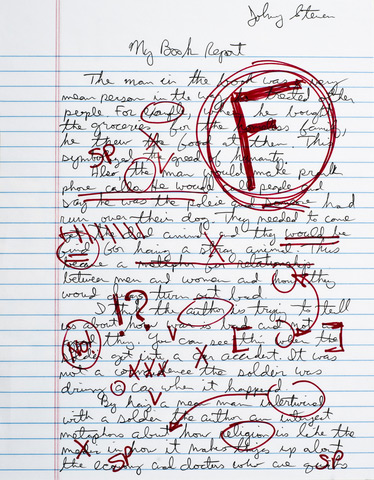
One caveat: whatever you do, don’t grade harshly on grammar. Let the ELA teachers handle that. Getting back a paper covered in red or green ink indicating where commas go is the fastest way to kill student interest in the benefits of writing. ELA teachers know which conventions mistakes are most important and how to address them. Let them do it. The ideas and processes are the important parts.
So a Learner’s Notebook becomes a record of students’ work to refer back to at the end of a unit. It gets students’ faces out of their devices for a change, too. It becomes a place where students use writing to learn … and to demonstrate knowledge and mastery of a topic.
And by the way, be sure to make colored pencils and markers available for students to use. Everyone can benefit from a little more color in their lives.

Leave a comment