What was your first word?
Of course, you don’t remember, but maybe your mom does. Or your dad, especially if it was “Da Da.”
My oldest child’s first word was “Ah-ee.” Luckily, I knew that this two-syllable utterance actually had a meaning. Otherwise, I might’ve missed this watershed baby book moment. She was referring to Octi, her favorite cuddly toy, a crocheted octopus hand made by a clever aunt.
Once she started talking, we quickly changed her name to Miss Verbose. Thirty-plus years later, she is fluent in two foreign languages and another regional dialect. She can even pick out several words and phrases in two additional languages. I’m pretty proud of her linguistic achievements.
Then there’s my son—the one who took college Latin and Russian as a high schooler. Russian, for heaven’s sake, with its Cyrillic alphabet and cold, guttural sounds! He spent a summer immersed in Brazil and surrounded by Portuguese speakers without knowing their language. He managed, he said, by just adding Spanish sounding endings to Latin words. Later, he studied Italian in college.
I’d like to think I can take some credit for their proclivity for language acquisition. I mean, I am a retired English LANGUAGE Arts teacher.
But it just ain’t so.
As a pretty good mimic, I’ve managed to learn several mostly useless travel phrases in Japanese and German over the years when we had exchange students. I can parrot the Pimsler sounds and string together a decent “Where is Shinjuku Avenue” with the best of the Japanese learners.
I can also bust out a few words in Spanish. Even a few phrases. And my accent is lovely, or so I’ve been told. That comes from learning from a native Spanish speaker in high school. I used to take pride in being able to utter my few phrases and sound like a native, even though I never did get the hang of conjugating on the fly.
My proclivity for being a good mimic was the cause of one of my worst teaching nightmare scenarios. And it was all due to my false ethos… and my false pride.
Are those rhetorical fallacies? They should be.
I’d spent the previous week sightseeing in Lima, Peru, and had been able to successfully use a few common phrases in Spanish. I was feeling pretty proud of myself. I could ask directions and the cost of something in a store— even haggle a little. Now I was headed to Huaraz for the working part of the trip where I’d be speaking to teachers at a local school about using writing workshop in their English classes.
So, of course, when I got to Huaraz, I wanted to politely greet my host. In my perfectly accented Spanish, I offered a lovely greeting and introduced myself before quickly switching back to my comfortable English.
When he complimented my Spanish, I casually mentioned to him that I had minored in Spanish in college— only thirty long years earlier.
My host clapped his hands in delight saying, “How wonderful that you will be able to speak to the teachers in Spanish!”
My heart leaped into my lame, Spanish-speaking throat. It’d NEVER occurred to me that I might need to deliver the presentation in Spanish!
How do you say “Duh!” in Spanish? Of course, they would prefer too hear a presentation in Spanish.
And, of course, there was NO WAY I would be able to pull that off.
For the next few days that I had to settle into the hostel and enjoy my new surroundings before my meeting, I panicked. I tuned out everything, instead rehearsing how to say each part of the presentation in present tense. I hiked the beautiful hilly streets of Huaraz, mining my brain for the Spanish words buried so deeply under the years of nonsense that had filled my head. I ate Peruvian pizza and gelato while grasping for Spanish talk-arounds that might make some sense to the teachers. I sat on the house’s concrete rooftop ignoring the imposing snow-covered majesty of Mount Huascarán in the distance as I tried to create present-tense Spanish phrases about writing.
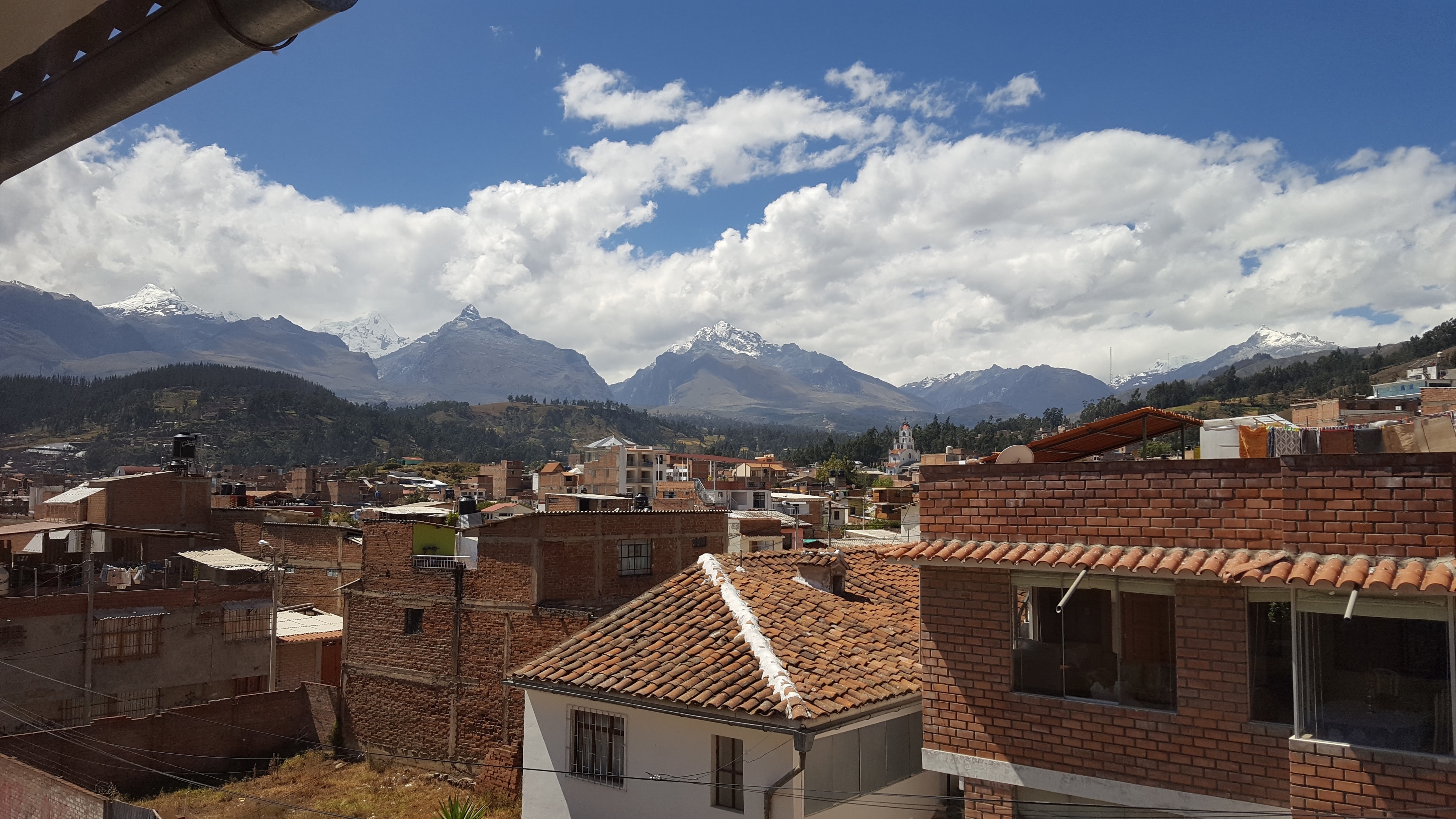
Even my dreams were filled with anxiety. I stood before the group mumbling as I tried to recall Spanish vocabulary words from my Points of Departure college conversational textbook. All the while I prayed for a miracle: “God help me speak Spanish well enough for the presentation to be intelligible.”
After three days of anguish, finally, I realized the obvious once again. Sometimes I can be so obtuse. Maybe it was in answer to my prayers.
Just admit that you can’t do it. Either that or claim that you only live in the moment as an excuse for only speaking in a rough present tense.

While strolling downtown with my host’s twenty-something daughter the day before the presentation, I took a deep breath. “I’m afraid my Spanish isn’t strong enough to use with Spanish-speaking teachers,” I told her.
My face must’ve been plastered with desperation. She exploded in laughter.
“You don’t have to give the presentation in Spanish! We didn’t expect that you would. All the teachers are fluent in English.”
My shoulders slumped as if two gigantic Spanish-English dictionaries had just slid off them. Are you kidding? All that anxiety for nothing? All the ignoring of the amazing sights around me because I was trying to find a way to communicate in a language that I didn’t really know?
Of COURSE, they all were fluent in English!
And they were. The presentation was well received, and I answered a few questions in English afterward.
Since then, I’ve learned some lessons. It’s good to have a few phrases to speak in a native tongue when visiting a new place. They show respect for your hosts. But don’t get cocky. Don’t be too spot-on with your pronunciations. People will make assumptions.
I admitted that I just don’t have the natural chops to be mistaken for being bi-lingual. I’m just a parrot.
But then time went on, and somehow I had those grandiose notions again. I could be fluent. I visualize myself speaking beautifully in another language and being understood.
Before my teacher trip to India, I bought a CD called How to Learn Hindi. In the name of cultural connections, I thought I’d teach my students some phrases before I left and learn a few phrases I could use.
But Hindi is not Japanese, and certainly not Spanish. No, the consonants in Hindi all sound the same to me.
First of all, the CD teacher directed me to pronounce the vowels. That was okay, even a little fun to try to make unusual sounds. I succeeded in giving a fairly decent imitation, so pleased with myself, I advanced to the vowels with nasal intonation. This required careful listening and a couple of tries each to pronounce, but they were still manageable, even at 40 miles per hour as I drove home from school.
But the consonants that came next put me over the edge. All fifty of them, or so it seemed. And that was only part one of Chapter One.
If I couldn’t even get past the preview of Chapter One, how would I ever handle the written language? To me, it looks like the intricate scrollwork on a piece of silver Mexican jewelry. Of course, it isn’t. Those beautiful squiggles are letters and words. Words to be deciphered. Words that have meaning… like where is the restroom- a phrase I definitely would need to know.
But as with my Huarez experience, this Hindu language learning turned out to be unnecessary. Abandoning my highfalutin goals was wise. No anxiety for me.
It turned out that their naive tongue was Malayalam, anyway. And everyone I met in India spoke English. In fact, better English than I- formal British English.
So instead of wrestling with pronouncing Hindu words, I spent my time trying to beef up my English diction in front of fourteen-year-olds, so they would’t remember me as that American teacher who spoke in such a low register of English.

Anxiety, thee has a new face and tongue. And it is my own!
Now that I’m retired, I’ve abandoned the language acquisition challenge.
Unless I count piano lessons as learning a new language. My piano teacher does. Every week, she makes a connection to language learning, reading notes, and both staffs and dynamics and time signatures and note values. It’s turning out to be a decent substitute. I can already “read” and play “Eliza Jane.”
But every once in awhile, I slip back into my former beliefs, thinking I have some capacity for foreign language.
Then I bust out a phrase or two in Gibberish, just to keep my kids guessing.

Leave a comment