It was beginning to seem like a game of tag… to find out as much as possible about my three times great aunt, Mary Jane Edwards who went South with her sister Lizzie– my three times great grandmother– to teach freedmen right after the Civil War.
And it was filled with stops and starts, dashes, and tactical quick pivots, as all good games of tag are.
It started when my second Lilly Teacher Creativity Fellowship proposal was approved. Every year, the Lilly Foundation generously funds one hundred or more Indiana teachers in their projects for personal renewal. Lilly wisely knows that being in K-12 education is a draining and difficult profession, and they are eager to support educators’ commitments to Indiana schools.
So, I set out in June of 2019 to make my proposal– and ancestors– come to life. All I had was a rough transcription of Mary Jane’s spidery handwritten 1866 diary, Lizzie’s gold ring, and a few stories from my mom and Papaw Holloway.
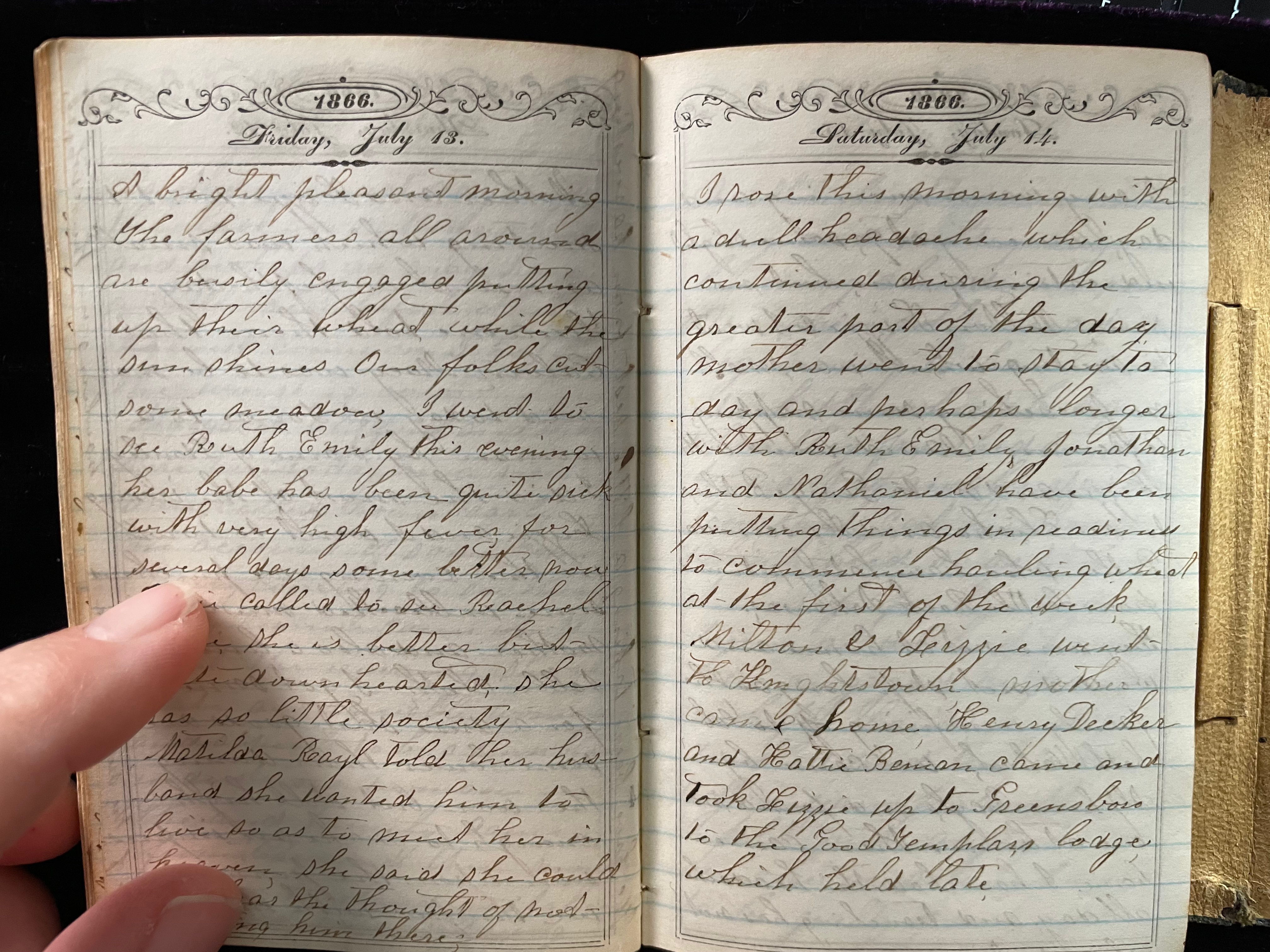
My original Lilly proposal included a multi-generational journey following in the footsteps of Mary Jane and Lizzie. Because the two sisters had traveled together on their adventure, I planned for my sister and daughter to help me on the out-of-state part of our research. We would take Amtrak south from Chicago along the Illinois Central Line through Mattoon, Illinois, and then work our way across Mississippi and Arkansas, hunting for sites mentioned in Mary Jane’s little black diary. Along the way, we would use nearby research facilities to flesh out details and with luck, locate the remains of their experiences. We had contacts at each stop who would provide us historical insight and guidance.
But, as if by a parent calling us home for the evening, our adventure stalled.
Mom got sick, and my sister was transporting her for regular treatments that left her tired and weak. Neither of them was available. Then my daughter’s shoulder injury flared up. She couldn’t help either. I was it.
My heart sank. The summer of renewal was going to be a bust. It was selfish, but I couldn’t shrug it off.
Then my history buff son Ted offered his help for the first full week of research in Indiana. He had two weeks off between jobs, so he happened to be available. I contacted Lilly, and they generously agreed to allow me to split my grant into two summers. The tag team now included Ted.
So we gathered our computers, a power strip, an iPad, chart paper, and plat maps and took off for our first base camp. We would be only 45 miles away in Richmond, Indiana, home to Earlham College and at one time the largest number of Quakers in the US. That location was important. Lizzie and Mary Jane were our Quaker ancestors who lived in nearby Henry County, Indiana, and Earlham College had archives of Society of Friends material with an archivist par excellence.
Our airbnb was a cool log cabin, part of the historical vibe I’d infused into my Lilly proposal. It did have a few modern amenities– after all, this was supposed to be a restorative quest, so my eyes lit up as we walked past the in-ground pool and a hot tub on our way to the cabin’s front door. In ear
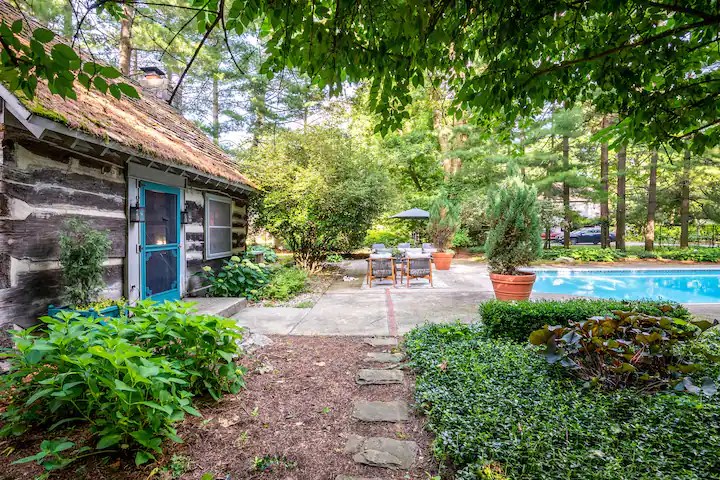
ly June, the pool water surely wouldn’t be warm enough, but what a place to relax between day trips!
The two-room cabin was suitably rustic. I claimed the loft bedroom and left the sleeper sofa to my son. I hoped to get a sense of early Indiana life from our time in Richmond. I figured climbing the ladder would mimic our Quaker ancestors’ early days after leaving North Carolina for western lands where slavery was illegal.
Ever mindful of our purpose, once we unpacked, I pulled out the large newsprint and created the week’s itinerary with a list of topics to research and painter-taped it to the mantle. I unpacked my new portable scanner and set it up to charge. Then I arranged our computers and reference material on the little table to process our field research work in the evenings. We had a strategy.
Satisfied with the prep work, before dinner, I took a stroll through the inviting gardens outside the cabin. I could imagine Mary Jane and Lizzie tending their own garden filled with vegetables and a few herbs like the lush foliage and flowers that welcomed me. How much time did it take to keep this garden so inviting, I wondered. The practical side of me guessed that our ancestors didn’t have much time for growing purely ornamental plants.
That night, I slept wonderfully, despite being perched in the loft in a twin bed and having to navigate the ladder for a middle-of-the night excursion. Granted, I had the benefits of an air conditioning unit stuffed into the tiny window, but I was beginning to feel a bit like an 1800’s girl– albeit one without a long dress to hinder my climb and descent.

The next day, Ted and I set out for Earlham, only a few miles from our secluded cabin. We spent the morning dashing between documents and books that the archivist had found for us and scanning away. We learned that both Lizzie and Mary Jane had attended Earlham before it was a college, then only called Friends Boarding School. We also read reports and accounts to and from the committee that sponsored their work in Jackson and later in Helena, Arkansas. My storage card was getting full, as we skimmed and scanned all morning.
Although I was engrossed in reading, Ted seemed to be getting antsy. Usually, he’s a little quiet in public, and being in a library, I didn’t expect anything else. But something didn’t seem right. He seemed uncomfortable, eager to leave. But he said he was okay.
Finally, I pulled away from my work, as the library staff headed for lunch. On the way to the car, I suggested we grab a sandwich and then take a drive around Richmond to look at some of the historical Friends sites that Ted had located for me. We passed old meetinghouses– Quaker churches– and tried to get the lay of the land near where the 1866 depot would’ve stood. I added to my growing list of questions and topics to research.
By the time we returned to our haven in the woods, Ted made a confession. He was in pain.
As a fifth grader, Ted suffered from a bout of kidney stones that landed him in Riley Children’s Hospital. Since then, he’s spent many hours in emergency rooms and surgery suites due to these acursed crystals. Numerous doctors have had no lasting solutions to help alleviate his unique variety, so he just has to deal with it from time to time. As a result, Ted has an amazingly high threshold for pain.
And usually he deals with it on his own, without his mama haranguing him about whether it’s time to go to the ER. Back at the cabin, he started making a personal Google Map of all the places we’d identified in the diary and planned to visit. “It takes my mind off the pain,” he assured me.
But hearing his occasional groans and seeing him fidget to get comfortable on a couch was alarming. I soon realized he must be in agony.
I found him some pain meds in my bag, but I couldn’t stop scolding myself. Maybe we shouldn’t have even tried to do this. Maybe I should’ve heeded the nudges when the others cancelled. Was our adventure over before it even had really begun?
I stopped to make a realistic mental status report: we’d located some information that would be interesting to read, but it was looking like the rest of the week was going to be a bust, just like the rest of my carefully crafted research agenda.
I settled onto a sofa to try to shake my negative attitude, but still keep an eye on my son. I picked up my copy of Mary Jane’s diary and began to read.
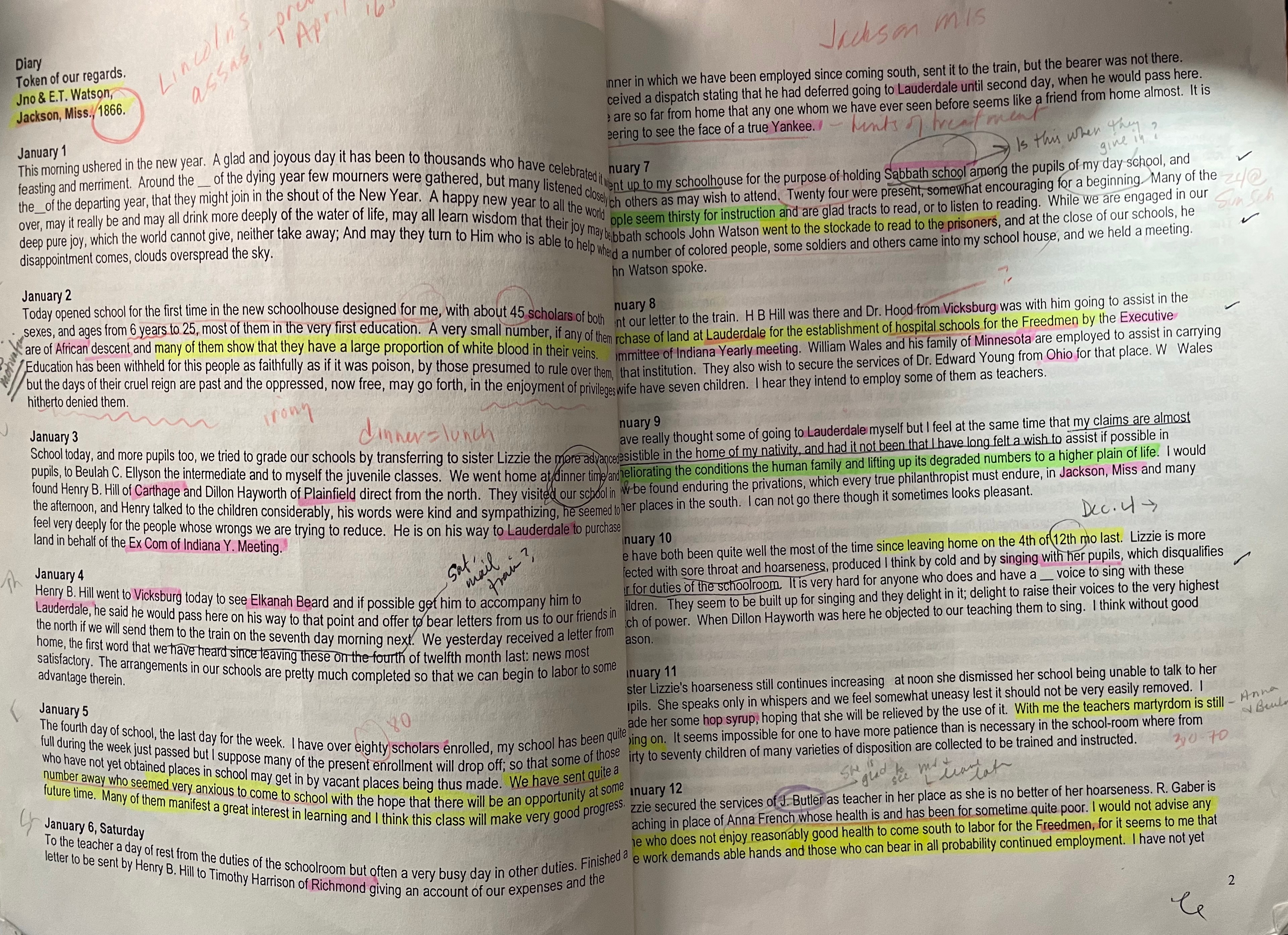
The sisters had been in Jackson, Mississippi, for about a month. Some of the northern teachers’ sore throats and hoarseness were preventing them from going to school to teach their classrooms of thirty to seventy students. The teachers were filling in for one another and wearing themselves down. That sounded like our situation!
On January 12, 1866, Mary wrote,
I would not advise anyone who does not enjoy reasonably good health to come south to labor for the Freedmen, for it seems to me that the work demands able hands and those who can bear in all probability continual employment. I have not yet missed any school since I began to teach, but I may not be so highly favored hereafter.
I set down the manuscript. Were we, Mary Jane’s descendants, hearty enough to take on the research of their trip? So far, it seemed not.
Short of taking Ted to ER, was there anything I could do to help him with his pain and salvage the week? One more time I reminded him, “Tell me if we need to go to the ER.”
This time, he didn’t just nod. “Mom, I don’t have the money to pay for that. Remember, I’m between jobs.”
“Right,” I said, my mind spinning. “Don’t worry. We’ll figure it out if you need to go.”
We both sat in silence, Ted’s face grimacing as he shifted his posture from time to time. I tried not to stare at him.
Lord, give us some help.
Then I remembered our walk to the cabin. There was a hot tub. A hot tub! It was time to pivot!
“Where’s the pain this time?”
“My back,” he said, without looking up from his computer.
“What about taking a soak in the hot tub?” I suggested.
He looked up, andI took that as potential interest.
“It should have jets that might make your back feel better.”
When he didn’t answer, I said, “Let me just go out and see if it’s turned on.”
I jumped up before he objected and bolted toward the door. Around the corner of the cabin, I found the covered tub was filled with hot water. All I had to do was push a button to turn on the jets.
Within minutes, Ted was settled in the hot, swirling water, letting it blast away some of his pain.
Back into the cabin, I picked up the diary again. Mary Jane had made her sister some hops syrup to relieve her hoarseness, while another teacher covered her classes. By Friday, she reported, the doctor had visited and “advised warm footbaths and mustard drafts applied to her throat.”
I set down my copy of the diary, that well-worn stapled packet of papers I had annotated in all colors of highlighter.
Although I didn’t have any home remedies like mustard drafts or hops syrup to help navigate Ted’s medical issue, we did have something else at hand. A hot tub. Not very historical, but it would have to do.
By morning, his kidney stone had shifted. And aside from being tired, Ted was ready to dive into our research again. We both had been tagged to continue our work, just as Mary Jane and Lizzie had. Our challenges certainly were different from theirs, but we used what we had at hand… with a little guidance from above.
I looked at the agenda hanging from the mantle and crossed off our trip to the archives. It looked like today, we’d back in the game.

Comments
One response to “Chasing our Quaker ancestors from a log cabin in the woods”
[…] funny that Mary Jane and Lizzie were aching for something just the opposite to excite their worship. They were eager to integrate […]
LikeLike