A journey to redefine retirement
How would you define “to do?”
There’s nothing particularly hard about the question. Especially if you’re a “doer“ like me. It means to get things accomplished. To stay busy. To work.
Since my early days in college when I worked thirty hours a week teaching kids and adults how to swim while carrying a full load of classes for a major and three minors, I’ve been a doer. I relished crossing off accomplishments in my datebook which was crammed with appointments, reminders, and tasks. I smiled in self-satisfaction when my blue or red Bic made that solid, thick mark through each line item.
Even later as a stay-at-home mom, I never wavered from my organizational practices. Instead of meetings, assignments, and work schedules, I made lists of what to clean, what to shop for and where, what mini adventures I might create for Baby Sally, or how a dollar could stretch a little farther.
The satisfying stroke of the pen, when I accomplished my daily goals, felt like a warm pat on my back. A flourish at the end of the line was a smile of appreciation from my inner self.

After the kids were in school and as a high school English teacher for twenty-five years, my organizational practices served me well. I could revamp lesson plans in the car, grade papers at basketball games, and enter grades on my iPad with 4G from any location. I was the poster girl for efficiency, and always with a list in hand.
But now, that’s all changing. I’ve retired, or so I’ve claimed to the government and my former school corporation. But have I really?
In this last year, I’ve found that moving into a satisfying retirement ain’t as easy as just sleeping in late some days.
During the last school year, I facilitated three teacher professional development programs, two of which lasted all year. I also finished writing and revising a novel and began a second one, kept up my Master Gardener and Herb Society status, took piano lessons for the first time, and expanded our home garden. Sprinkle in a few trips and visits from our granddaughter, and that pretty much rounds out my year.
No doubt, I expended less energy and time than I would’ve if I’d been teaching four preps and sponsoring a couple of extracurrics. But it was enough. Maybe too much. I didn’t feel retired. The grading was gone, but the lesson planning, the meetings, and the interpersonal work were still regular challenges for my introverted self.
So when It was time to hit the road for my second annual silent retreat at Prairiewoods Franciscan Spirituality Center, the car was clean and shiny.
At our first meeting, I read my newly assigned spiritual director my bulleted list of lofty goals for the week:
to rest after receiving my rude iron deficiency awakening
to ask for help from others when needed
to decide what was mine to do in this new land where I seem to have trouble saying no
My fifty-something director immediately suggested that I consider the concept of shifting from DOING into BEING, now that I was reaching the age of being an elder.
It was a fair nudge, although being called an elder was a little shocking.
But what did she mean by “being?” That definition was a little nebulous, so I asked her.
“Anything that is ‘life-giving,’” she responded.
Okaaaay. That made me squirm. Was I the only unenlightened one who didn’t think about this kind of thing on the daily? Or yearly? Was that what other retirees spent time doing? Clearly, there was much of my recent work that should be stamped LATE.
What would be life-giving for me? I pondered as I rocked the padded glider back and forth.
I get some joy from the things I do. I also get some irritation or fatigue occasionally. Don’t most people? Isn’t that just how life goes? Does that mean those activities aren’t life-giving or affirming?
Trying to return to the conversation, I shared a recent revelation of self-knowledge. “Well, I know that just because I CAN do something, that doesn’t mean I should do it,” I ventured.
But instantly, I felt like a moron. My great insight was the caption of a classroom management poster that’d been hanging on my wall for ten years. How could this concept only be something I’d just applied to my life?
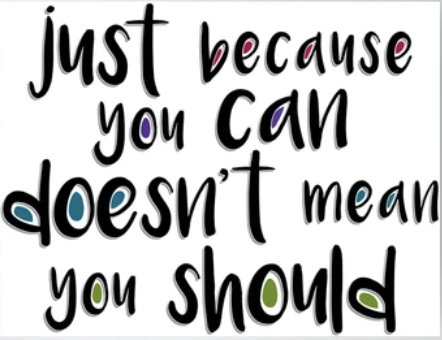
I tried again. “What I meant was that I don’t have to do something just because I can and it needs to be done.”
“That’s right! ‘No’ is a complete sentence, right? As in ‘No, I don’t have time to do that,’” she shared.
Well, not really, I thought. Technically, it’s an interjection when used alone and therefore a fragment. But I caught her drift.
She must have seen she’d lost my attention. “Think about your core values,” she prompted me. “Do the things on your lists fulfill them?”
My eyes darted to the side and then swept across the ceiling. I could tell her what my teaching values were in a trice. But my core values? When was the last time I’d made a list like that?
Maybe when I was a single mom and thought about what traits my potential future husband would need. Several detailed items filled that lengthy list, along with corresponding test questions to address my numerous standards.
My silence urged her to try once more. “Think about what you always imagined retirement to be. What did you dream you’d be doing? What did you dream your days would look like?”
Oh, she’s good, I thought. She must’ve been a teacher … and an excellent one, too. She’s now given me– her low-end student– several ways to access this concept.
“I’m not sure I ever thought about it.” I stammered, but I started scribbling ideas as she gave me an example from her own upbringing. Then she jumped up to pull a book off her shelf.
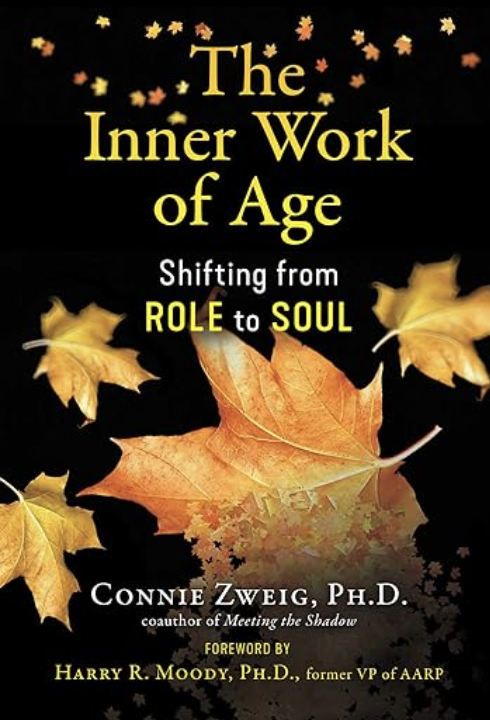
“This might help,” she said. “It’s called The Inner Work: from Role to Soul by Connie Zweig.” She handed it to me, and I flipped to the table of contents.
“Don’t feel like you have to read it all,” she counseled. “Just take a look at the chapters or parts that jump out to you. We can talk more tomorrow.”
“But here are some points you might consider as you think about becoming an elder,” she offered. I scribbled a new list.
What can you step away from doing?
How do you want to be a bridge for the next generation to a better place?
How can you let opportunities unfold, rather than plan them all?
“It’s tough work, this ‘being,’” she said softly. “We live in a culture where our worth is often determined by our work.”
I nodded. I looked down at my journal, filled with bullet points and dashes. My lists were a testament to the work I’d planned and also a celebration of the work I’d accomplished. Would my worth disappear if my lists disappeared?
I thanked her and edged out of the office, book in hand. It was going to be a long week.
