Our identities are being taken away, one pronoun at a time.
I’m not talking about the gender-based pronouns. During the last few years in the classroom, I just stopped using gender-based personal pronouns for fear of getting them wrong. I resorted to first names when I could remember the new ones, or just “you” as my fallback. As an old-school English teacher, I couldn’t reconcile myself to using they/them plurals for singular individuals. It wasn’t an especially strong practice for community building, but it was better than being sued.

Then, after I retired, certain non-gender, NON-specific pronouns started being attacked. I’m talking about the singular and plural second-person personal pronouns and first-person plural pronouns. What does all this grammar jargon mean? “You” and “your” have been purloined and replaced by “we” and “us.” And by servers, no less (and please notice that I have avoided using gender-specific terms for this profession). Yes, I’ve written about this before.
“What are we having this morning?” our server asks my husband and me at breakfast.
Once again, I bristle and take a deep breath, trying not to embarrass anyone by pointing out that the server should be using “you.”
“Are we having cream with that coffee?” the server continues. “How can I get us started today?”
Now, none of these people has ever been invited to sit with us and share a meal. Not that we wouldn’t make pleasant conversation and perhaps come away enlightened or entertained, but that’s a topic for another time.
In short, we don’t know these servers. They’re not part of our family or circle of friends. Unless we are huddled together waiting out a dangerous storm, the “we” aspect of our gathering isn’t really any part of our lives, as the two of us just enjoy an omelet on a Tuesday morning.

So what has happened to the singular and plural pronouns “you?” Why don’t servers of all ages use the plural form of “you” anymore? I’d even be happy with a “y’all” rather than the incorrect and irritating “we” and “us.”
When I get past the irritation, I wonder. Is it a rhetorical move? An inclusivity-driven ploy to make the customer feel friendlier toward the server and leave a larger tip? You know, “we’re in this experience together, so reward me amply.” Sometimes I ask them, to my husband’s rolled-eye dismay.
He’s getting used to just saying “retired English teacher” and nodding knowingly at the server, who will make a face and nod back at him. Then, probably in a well-practiced response from school days, the server will plead ignorance with something like, “Oh, do I say that? Ha ha! I didn’t realize it.” Pooh! I don’t believe it.
As a former ELA educator, I’ve been tempted to review the pronoun unit with all the servers who have lapsed, but I wonder if it is still being taught. What are teachers doing about pronouns today?
Honestly, I’ve just about been worn down enough to refrain from my even oft-used, sarcastic response. “Well, I’m having coffee–PAUSE–I don’t know what you’re having.” Frankly, it hasn’t corrected anything, just produced looks of confusion, so I might as well abort the entire mission.
But a new development in the pronoun field has made the lack of second-person pronouns seem relatively benign. It’s an alarmingly newish feature of Artificial Intelligence. And, at the risk of sounding like a kook, I think it has insidious designs on society.
Let me make it clear that I have strong reservations about AI. I know that it collates information from the Internet to create responses to prompts or conundrums. That could be a powerful collection of information. I also know that there is a LOT of crap on the Internet.

Does AI save time for humans? Sure. I used it to create a garden plan that I eventually had to abandon when my seedlings didn’t sprout. Does it see patterns and make organizational plans for teachers and writers? Yes, if you don’t mind using the average teacher’s work. Can it clean up writers’ work? Of course, but is that the individual’s own work? I’d argue no, it isn’t. Inside or outside of the classroom.
Does AI have the capability to do amazing things that an individual cannot? Probably. And that’s what’s kinda scary. Ever watched 2001: A Space Odyssey?
Okay, we’re not there. Yet.
But believe it or not, it’s apparently acceptable–or inching into becoming acceptable–for first-person pronouns to be used by inanimate objects as they “refer to themselves.” And I’m not talking about creative writing assignments from the POV of a drop of blood in science class.
No, Artificial Intelligence is now using the first-person singular to refer to itself in its responses. Recently, when I entered a search prompt that resulted in insufficient information, ChatGPT responded with an offer to do more.
“Can I help you…? Would you like me to…?” ChatGPT asked.
“I?” “Me?” My eyes bugged out as I read.
“NO!” I shouted at the screen.
“ChatGPT, you are not a sentient being. YOU cannot help me because YOU are not a person,” I wanted to type, as I was nearly pulled into a heated text exchange with a machine, not a person. It was like talking back to the phone when I get caught in a recording loop, except that this response was personalized–to me and my prompt.
It feels like I’m in the movie: “I’m sorry, Barb. I’m afraid I can’t do that,” HAL–I mean Chat says in such a soothing, mellow voice.
Now that’s scary! And not from a pronoun perspective.

But let me step back. I wonder about the personal impact of a computer that “talks” to me, as if it were alive, a device with singular first-person pronouns: I, me, my, mine.
If I use it frequently, how soon will I accept it as a unique individual? Will I believe that it has ideas? Maybe even emotions? Will I become like those young people who use AI as their bestie or their sweetie because they have limited social skills or mental health issues? Will I become addicted to its charms?
Stepping back further, what about its impact on society? What are the goals of AI developers in using these singular personal pronouns? Are they trying to condition me to accept Artificial Intelligence as “someone” worthy of respect?
I think I can resist that. I hope I can.
But what will happen when AI starts using plural pronouns, like the servers at the restaurant: we, us, our, ours? Instead of being out to eat together and my feeling more companionable with the server (who is motivated by wanting a bigger tip), will that diction suggest to me that AI and I are in a conundrum together? Will I be more tempted to follow the suggestions–or dictates–of AI because I have been lured into thinking we’re a team?
That concerns me.
“Oh, Barb, stop being so suspicious,” I can hear some family members say. Really, isn’t it just like when Teddy Ruxpin’s mouth began moving and a voice came out? You had no problem when he entertained your kids back in the day. No, Teddy was playing a prerecorded story from the cassette tape inserted into his back. Even Newton Gimmick didn’t claim to have all the answers from scouring the “wealth” of information across the Internet.
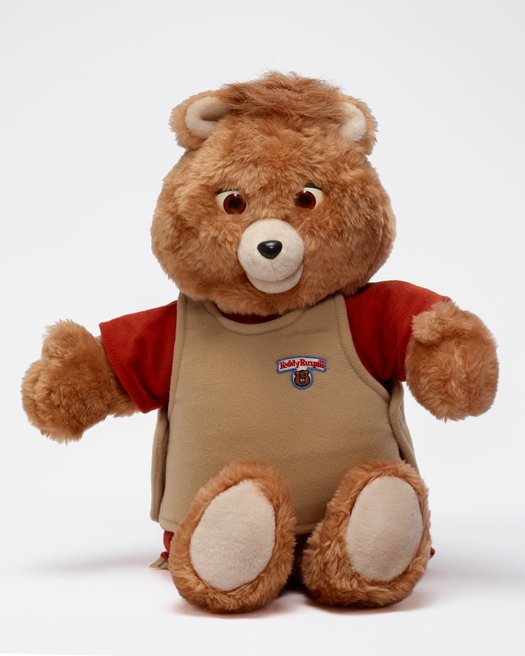
Well then, isn’t it like calling an automated helpline? No. There may be different responses for different buttons or keywords, but again, it’s all prerecorded. There’s nothing uniquely tailored to an individual caller. And it doesn’t overtly claim to be a person. No pronouns are being used surreptitiously.
But language changes. English is a living language, and we should expect new uses as times change. Okay, I’m willing to accept “gift” as a verb, even if I’d never use it, but assigning pronouns to inanimate machines that have no brains has more potential harm than just changing a part of speech.
The corruption of pronouns to include inanimate objects via Artificial Intelligence promotes the insidious and erroneous concept of AI as human–or even more than human with its supposed omniscience and wisdom. It promotes AI as a god.
It’s enough to create a horrifying sci-fi narrative, where humans are at the mercy of machines before they even know it.
Oh, wait.
