What would be the worst thing you could find out about your family?
Several years ago, when I was writing a play about a local murder that took place in the 1930s, a friend suggested I try to find the ancestors of the young man who committed the heinous act and interview them.
Through Ancestry.com, I thought I tracked them to a nearby small town, only about 20 miles away. Using Google, I found the address where the family lived. It would be easy to take a Saturday morning to drive over with a list of questions about their great-great uncle. He had died years ago, so the possibility of their even having met him was slim, so some friends I asked about it thought it would be no big deal.
But I just couldn’t do it.
I mean, how do you ask someone about a relative who was convicted of murdering his father? Do you share the information that you’ve tracked down, asking about the hunch that he changed his name and spent time in the military, even as a POW in Germany?
What would they say? What would they think when a stranger came probing for details that they might not even know? Much less care to stir up?
In the end, I said no. Barging in with questions seemed so intrusive and inconsiderate. After all, they had nothing to do with the choices and actions of their relative. And the case was complicated enough, with references to the father’s philandering and alcoholism, and the youth’s eventual confinement for mental illness.
How would I feel if dark secrets about my family were ever to arise?
That didn’t seem very likely at the time, but still, it helped to imagine how I might react to tawdry skeletons in my family’s closet.
Now, I know.
Heads-up: I don’t have a murderer in my family.
But I do have some unsavory behavior in my bloodline. And thanks to tools that genealogists and anyone else surfing the web can use, I have more questions than answers. I may also have some rich fodder for a new novel based on the real-life struggles of people who share my DNA.
A few weeks ago, I was stumped and feeling frustrated, so I took a break from researching an article for a local historical group’s newsletter. For some reason, I began wondering about my grandmother’s side of the family. My mom has never talked much about that side of the family, except that she called her grandmother “Ah” because her mother had called her own grandmother “Ah.” And that Mom had an uncle who always drove a brand-new Cadillac down from Detroit each year to show off to her dad.

So, not knowing the deep fall I’d take, careening into rabbit holes and getting tangled up in roots of making facts out of snippets of their lives, I opened that family tree on Ancestry and began clicking on the numerous leaves or hints. I had no idea where the attached documents would take me.
Boy, was I surprised!
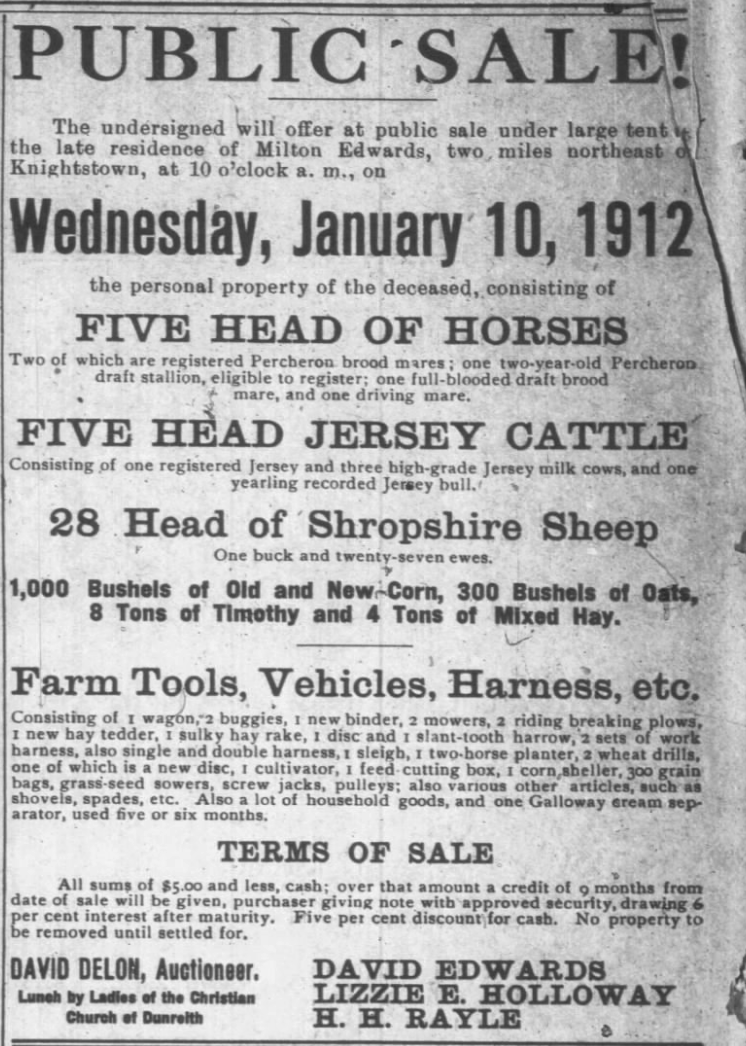
One of the best research tools I’ve invested in is Newspapers.com. During the pandemic, I used it with my students when they dug into various places around the township to create historical driving tours. I’ve been hooked on using it ever since. Finding articles about specific people and the noteworthy events in their lives makes them real to me, much more tangible than just a name, a location, and a few dates on a sprawling family tree. I’ve used Newspapers to uncover tangential, but cool information about my ancestors while writing a novel based on an Edwards ancestor’s diary. It’s not only the accounts of their lives, though, that helped me create their world. Reading the ads and the editorials allowed me to build context and add local color to the 1866 setting. Who knew my great uncle raised Percherons?
I had no idea how much information Newspapers would provide about the other side of my family. Because Newspapers.com is now linked to Ancestry.com, and I have accounts for both, I was in for some juicy information
One of the first things that I found and remembered was that my great-grandmother’s name was Lola. That must’ve been the root of the nickname “Ah.” But a generation earlier, her mother’s name was Sarah– the first “Ah”- just like my daughter’s name, although I didn’t know it was a family name when we chose it.
From opening the census ledgers in Ancestry, I discovered that Lola had actually been named Sarah Lola, and she’d been a milliner. How cool! Another Sarah AND a milliner! I’ve always fancied the idea of wearing stylish hats, although I never know how to handle the bedhead look when I take them off. Maybe that explained the provenance of the box of antique milliners’ feathers that my mom gave me many years ago when she was downsizing!
The background information I had about my great-grandmother Lola was scant. I knew she’d worked at a locally famous department store in my hometown before she married: my sister inherited the petite desk and matching chair her boss gave the couple as a wedding gift. I knew that she loved to brush my mom’s hair in the evenings when my mom was a little girl who‘d walked across the field and through the chicken yard of their dairy farm to visit her in the big house.
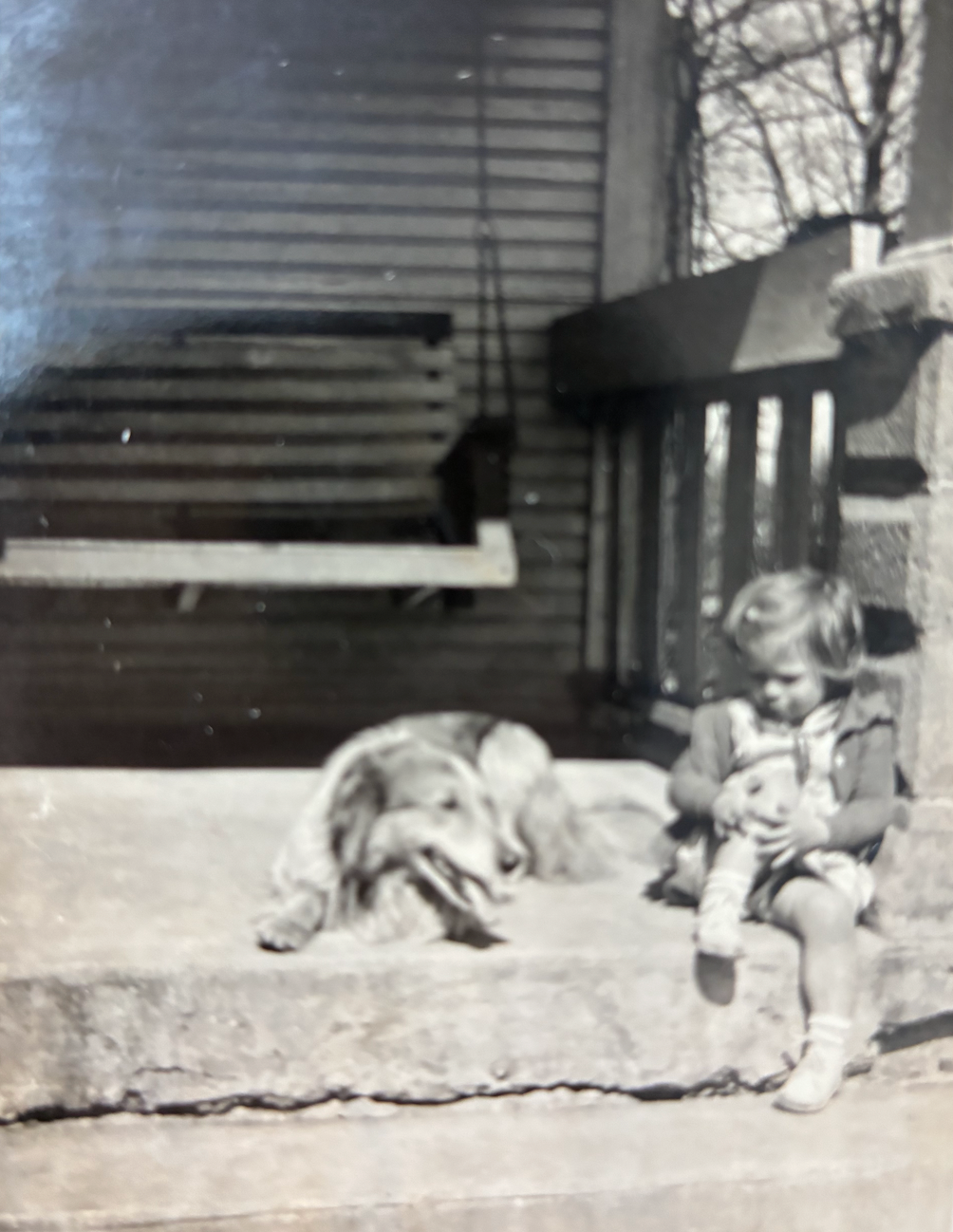
I’d been told that Ah put pennies on my mom’s eyes when she napped on the window seat of their home. I also knew she never allowed my grandmother or my mom in the kitchen and that when she carried around a pencil and tiny tablet, her husband knew she had some kind of renovation in mind. She seemed like a pretty savvy woman with a strong personality.
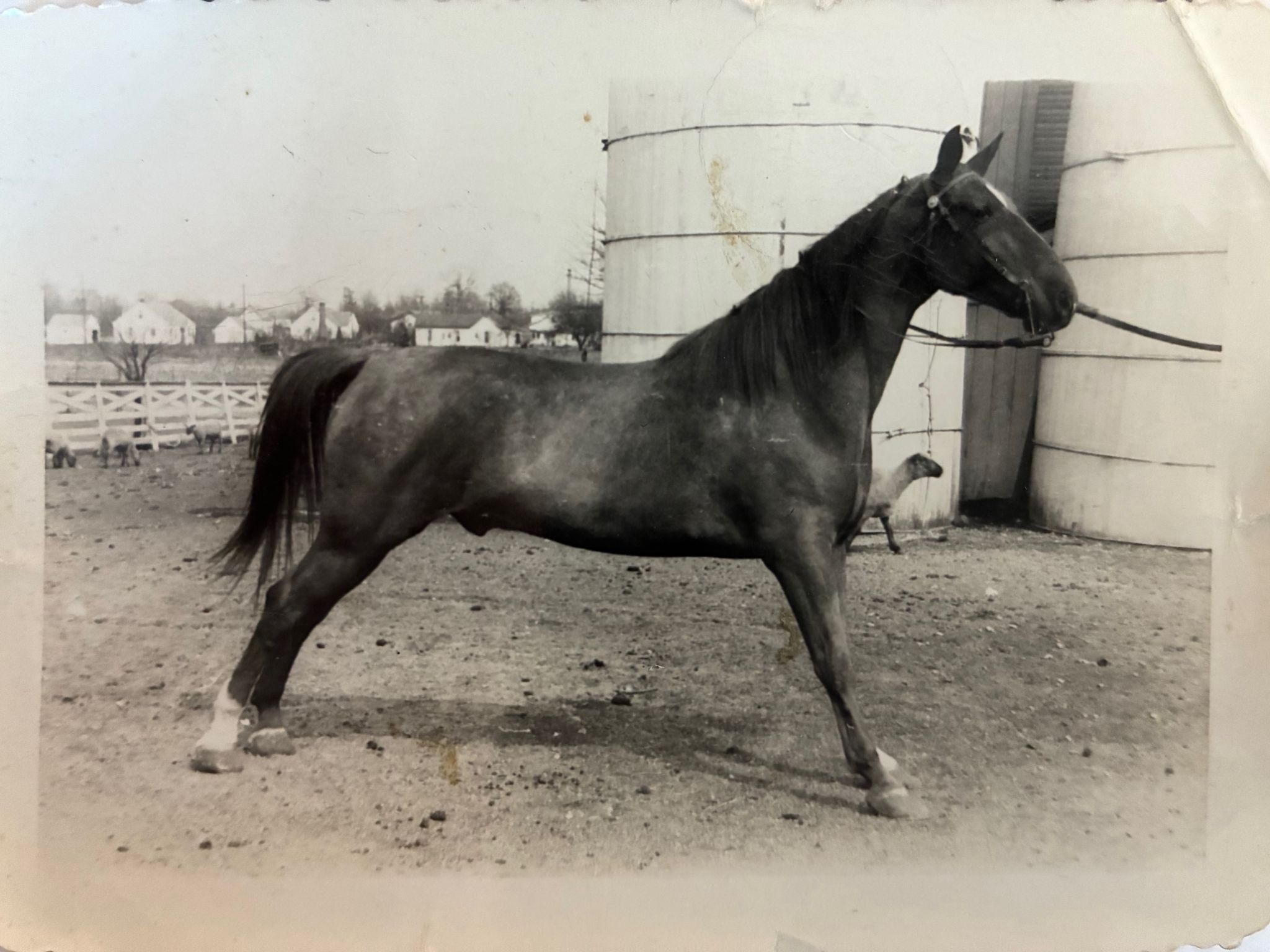
Mom knew even less about her grandpa, but mostly remembered that he’d been fun in spirit and had a “big scary racehorse named Rex.” Later, she happened to find a photo of Maud Rex stuffed in a Ziplock bag.
I also knew that the couple had died too young. When my mother was ten, she answered the phone call that brought the horrible news. Her beloved grandparents had been asphyxiated in a Florida hotel due to a faulty gas connection. It was a trauma my mom still tears up about today.
From census information in Ancestry, I learned a few more things about my great-grandmother Lola: after she was a milliner, she was a clerk, and in 1910, she was a bookkeeper at a dry goods store. At that time, her name was also inverted; she was now Lola Sarah Millikan. Maybe it was too confusing to have two Sarahs in the family.
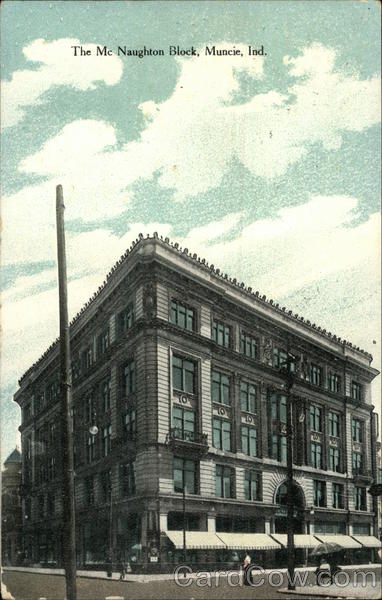
Having the bare facts, I turned to Newspapers to fill in some gaps in their lives, the more interesting bits. I discovered that from the 1890s on, Lola was listed as a member of several society clubs and included in newspaper accounts of their outings and events. In 1914, she married a man who was several years younger than she. Strangely, for being a bookkeeper who works with numbers every day, her census age didn’t quite keep pace with the years. In 1930, her age was listed as only three years older than her husband’s. By the 1940 census, her birth year was reported as four years later than it originally was. By the time she died, her tombstone revealed that she was actually seven years older than her husband!
Who was fibbing and why, I wondered.
And what about her parents? I had no information about them.
Grandma Sarah Melissa, Lola’s mother, was next on the research list. I started with the ten-year censuses, linked to her name in Ancestry. Of course, I had to ensure that the names and dates on the pop-up hints were accurate, because census takers had notoriously bad spelling and often only marginally legible handwriting.
Here’s what I found:
In 1860, eleven-year-old Sarah lived with her parents and six siblings in Wells County, Indiana, on their family farm. The family seemed well off, with $6,000 reported in real estate assets and a personal estate valued at $1000.
But by July 1870, her father had died in Gallatin, Tennessee, at age 47, leaving her mother with five children still at home working the farm, and real estate values reduced to $2,000.
That led me to a marriage record. The following September, at age 21, Sarah married Ezra, a Civil War veteran who was working as a carpenter. According to the 1880 census, within two years of their marriage, their first daughter was born, and then a son the following year. In 1878, Sarah Lola was born.
In 1880, the family of five was living in Wells County, Indiana, with Ezra doing carpentry work and Sarah keeping house. Two-year-old Lola did not attend school, but the others did, and no boxes were ticked to indicate anyone’s inability to read or write.
Ten years later, in 1900, Sarah reported having had 4 children, but only 3 were still living. She and 22-year-old “Leola” lived with her husband Ezra, who was recorded as unable to read or write, but could speak. “Leola” was reported as a milliner.
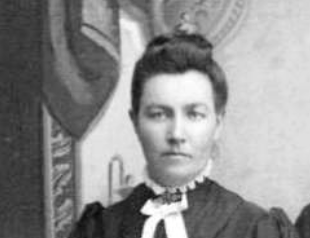
I had more questions: what was the report of Ezra’s illiteracy based on? Had he become disabled?
I turned to Newspapers.com for more information. In 1892, there was the first public record of problems: Ezra was arrested for provoking a doctor. He was arrested and fined $8.
Was this typical behavior for Ezra? Or was his outburst related to the loss of their fourth child? I wanted to know more about him.
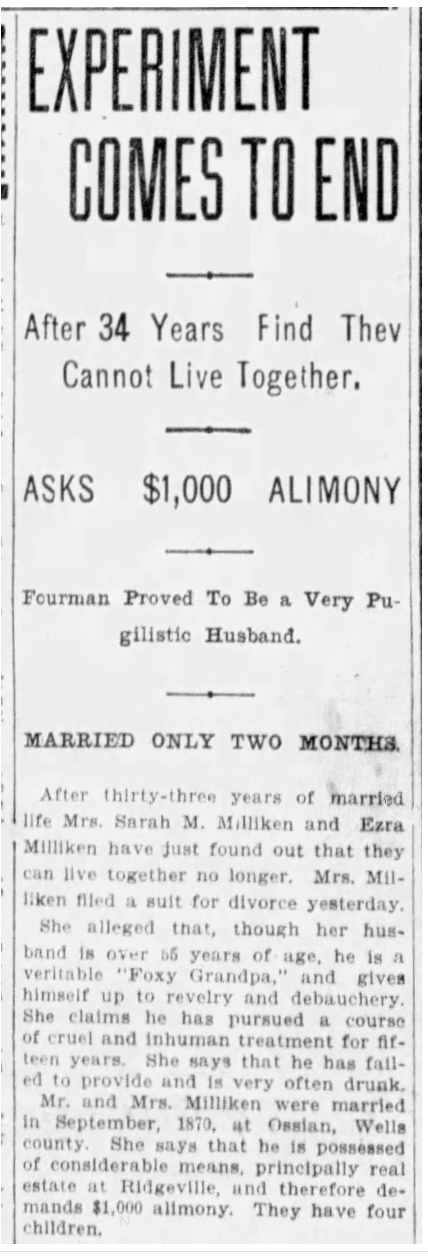
From there, the information was scattered in all directions. I scrolled through Ezra’s default Ancestry timeline, only to find a sad newspaper clipping. “Ezra a Poor Husband,” dated October 1903. Yes, it was our Ezra. The article reported that Ezra did not contest the divorce his wife Sarah had filed.
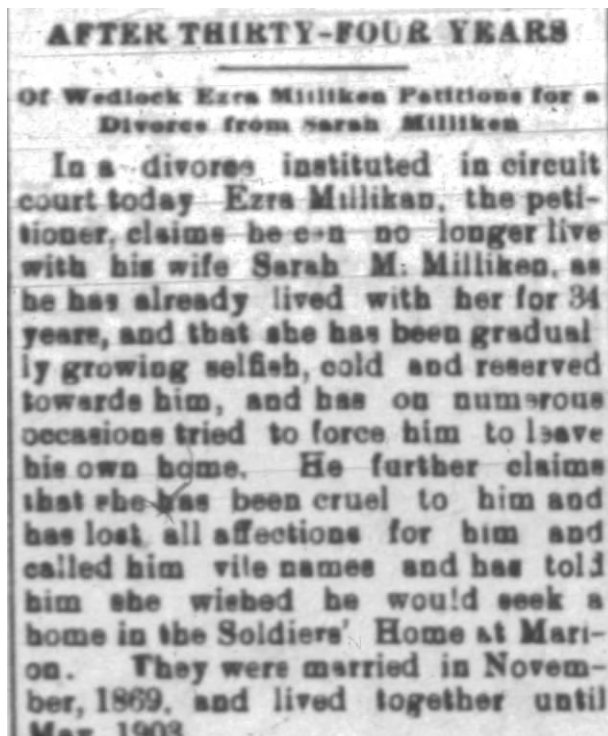
Divorce! I wasn’t expecting that. Not in 1903! Not in my family!
Another article popped up featuring Sarah’s side of the divorce story. She considered Ezra a “foxy Grandpa,” the name of a popular play at the time. She also accused him of “revelry and debauchery” and claimed that he had treated her cruelly for fifteen years. She demanded he pay her $1000 alimony from his generous estate.
This was incredible! No wonder we hadn’t heard much about this side of the family!
Scrolling further down through Ancestry’s hints, I found the words “Crazed by Drink.” My heart sank. Their story wasn’t over once they were divorced. It seemed that after the divorce, Ezra had tried to come into Sarah’s house while carrying concealed weapons. In front of the judge after the incident, he was reported to have wept and trembled in regret.
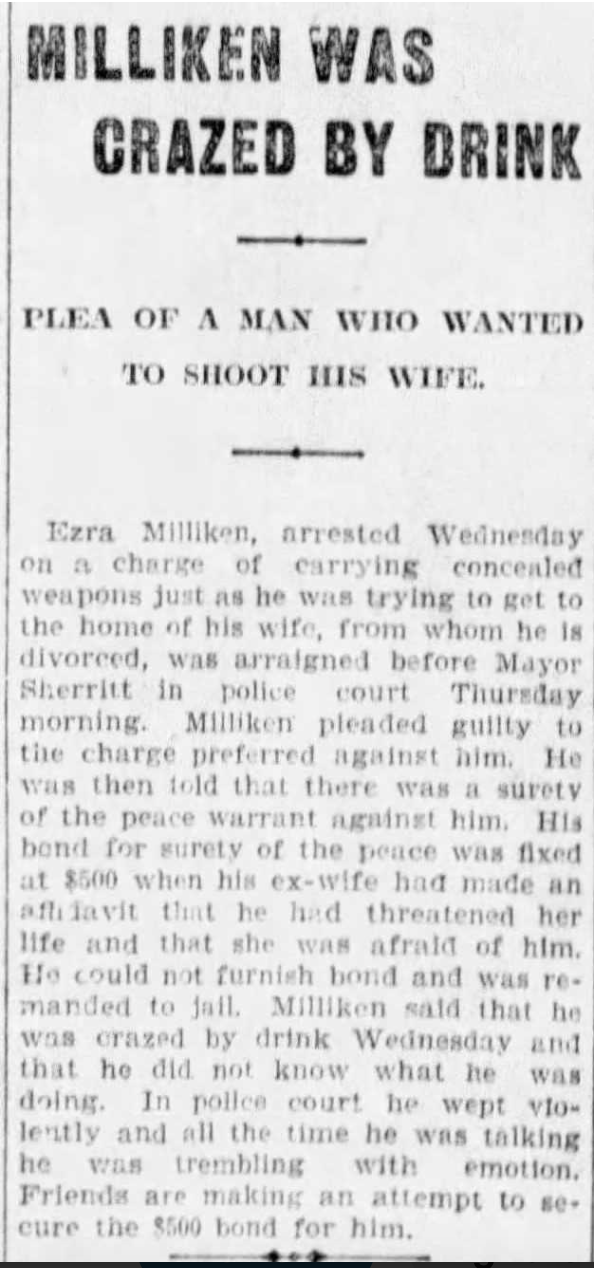
Now I was starting to become defensive of these ancestors I didn’t know. What parts of this story were not being told in this very public forum?
When I found Ezra’s headstone and grave linked to FindaGrave.com, I saw that Ezra was buried at the Marion National Cemetery in Grant County, Indiana. That’s where a VA hospital is located today. Was there a connection? The dates and the shape of the military emblem on the grave marker suggested to me that he had served in the Civil War. That was correct.
An obituary from Blufton, Indiana, reported that he had lived at the Marion Soldiers Home for the last few years of his life, and that, although he’d been ill, his death came suddenly, while he sat in a chair. According to blurbs in the Marion newspaper, Ezra pulled extra carpenter duty occasionally and seemed to be a model resident. I also learned some of Ezra’s history: he had enlisted at the age of 16 in Company F of the 130th Indiana Regiment and mustered out at the end of the war, five years before he married Sarah. Age 16!
I had so many questions! What did Ezra do after the war ended? How did he meet Sarah? How did they decide to marry? Were they both trying to find a way out of hectic family households?
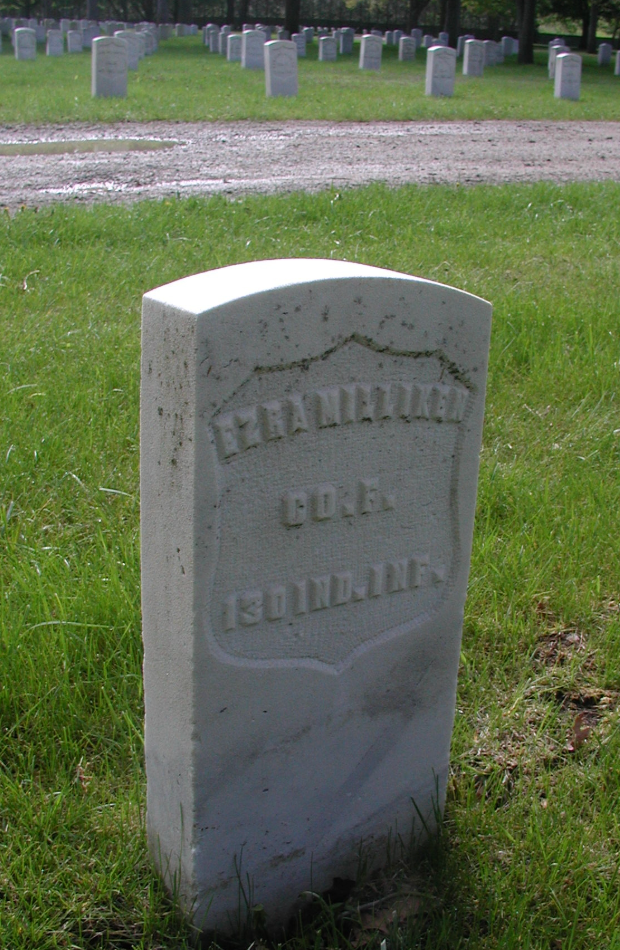
That information prompted me to look up the 130th Indiana. I found that they mustered up in Kokomo and then fought all over the Southern US, from Tennessee to Georgia, Alabama to Washington D.C., and on to North Carolina. By the end of the war, the regiment had lost 38 men in battle and 147 to illness. What had young Ezra and so many of his military companions witnessed and participated in during the two years of their service?
His life seemed so sad! What traumas had he experienced at age 16, I wondered. Did they contribute to his failed marriage? Was he happy to finally live alone without Sarah?
And how had that failed marriage at the turn of the century impacted his and Sarah’s children? And their children? How difficult would keeping a place in society be when your parents had had such a public divorce in the early 1900’s? Was she so involved in society events to just get out of the explosive household? Was that why Lola married so late in her life? Was that part of why she married a younger man, one who was known to race horses and win? Was that why she was so well organized and capable?
Will I ever know?
In my imagination, I’m finding grace for all of the players in this family drama. I imagine Ezra’s trauma that was untreated and led to addiction and foxiness. I see a strong Sarah having to take over the role of both parents and eventually coming to live with her youngest child because her husband had died at the Soldier’s Home, leaving her nothing. I envision Lola holding her head high in a time when divorce was uncommon and her parents’ troubles spilled onto the newspapers. I wonder about the parts of my family’s story that weren’t told, the parts that perhaps I could create.
But mostly, I smile at the memories that have been kept and passed along. Tall, sleek horses and cool coins on eyelids. Squishy chicken yards and luxuriously brushed hair. And I’m grateful that there are always at least two sides to every story.