
The crickets weren’t chirping. The birds huddling in the trees didn’t sing. No roosters crowed, and no soft breezes wafted through the open doorway.
Still, the 1857 Fall Creek Meeting House was full, as Friends gathered on a cold February morning, much as my Quaker ancestors did 150 years ago at Elm Grove Meeting House, some 30 miles away. Even though the meeting house wasn’t full of worshippers, it did spill over with faith and spirit and love, as Friends welcomed my daughter and me on Sunday.
Fall Creek Meeting is unprogrammed in its format. That means that those gathered to worship center themselves to quietly pray, commune with the Holy Spirit, and perhaps share the wisdom they’ve received or concerns on their hearts when they feel so led.
It’s my kind of silence. It restores me. It connects me with what is most important.

But spending an hour in quiet contemplation and prayer isn’t always easy. I’ll admit it: sometimes my mind wanders.
This Sunday, we sat adjacent to the wooden outside door, one of several that I suspect are left over from the old days when men sat on one side of the room and women on the other.
It wasn’t a misogynistic setup: it merely facilitated better focus on the task at hand: communing with God. How much easier it would have been to tend to your own spiritual life without your spouse seated next to you! And when it came time for business affairs, women likewise weren’t distracted or intimidated by men’s views when they sat on the other side of a dividing curtain or partition. No, they could freely discuss their concerns among themselves and then report back to the men.
Those segregated days are long gone, but there I sat on an old oak pew that countless Friends had shared. It was a downright cold morning, one that taxed my concentration. I tried to ignore the occasional opening and closing of the door and the frosty gusts of wind that whooshed across my right side as people slipped in and out of the room. But the chill pulled my thoughts from above and back into the room. I finally opened my eyes.
That’s when I noticed them.
Neatly hanging across the backs of most of the pews in front of me were colorful afghans. I glanced around the room and saw quilts and blankets, too, all spread out in their full glory spread across the backs of nearly every long bench.

It was a thoughtful touch.
Practical, too.
Fall Creek Friends must’ve known that the tiny meetinghouse was likely to be chilly on an Indiana winter morning. After all, it’s a plain space– one in keeping with Friends’ testimony of simplicity and with the meager budget that a small membership affords.
Then I noticed something else: none of the throws matched.
Directly in front of me was a crocheted afghan in a chevron pattern. Its thick dark rust, brown, and ochre yarns zigged and zagged neatly together, promising a warm winter hug.
I glanced back at my seat and realized I was leaning against a fringed Mexican blanket in gray, cream, and seafoam green. It matched my sweater! I pulled it around me and instinctively smiled at the instant, stylish warmth.
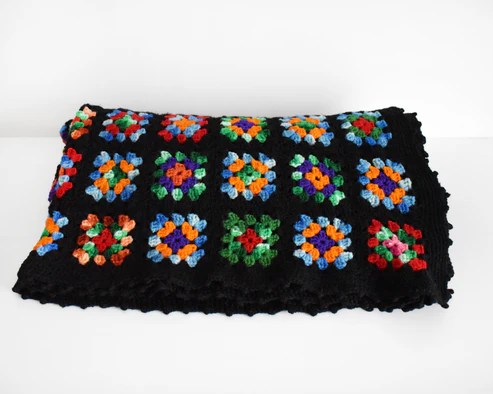
Behind me, distinctive, jewel-toned starburst circles within crocheted squares were held together wth black yarn to create a Granny Square afghan. I thought of my childhood bestie’s mother. Always relaxing with a Granny Square in hand, she deftly orchestrated her crochet hook in and out, and side to side, like a conductor, hooking and tugging the yarn ball that bobbed at her feet. Her colorful masterpieces were as soothing as any symphony.
A few pews forward, tie-dyed purple and pink circles popped off the lime-green background of a hipster quilt. To its left, a thick afghan crocheted with wide earth-toned stripes in avocado and rust awaited a chilled Friend’s reach. To the far left, a more delicate throw, perhaps knitted, with alternating smooth, wide, and slender stripes in muted colors, lay in wait.
My mind began making connections, seeing a pattern and the connection Friends have to the many blankets scattered around the meeting room.
All of the throws, each one unique and different in appearance, style, and form, but carefully arranged, were placed there for the same reason: solely to comfort Friends of all stripes.
And Friends do come in many versions.
When many people think of Friends, they picture a smiling, white-haired man wearing a wide-brimmed black hat. He is plain, generally cheerful, and exudes honesty. At least that’s the reputation the Quaker Oats company counted on to reassure its consumers, and their caricature has become the quintessential Quaker.

The image is hardly historically accurate. His clothing is the wrong color, and his hat is the wrong style. His hair is too long and showy, and his big smile belies a sense of frivolity that does not reflect the seriousness that Quakers insisted upon for all members of the Society of Friends.
But for all their insistence on equality and sameness, Quakers are a diverse lot.
Even in the 1800s, Quaker meetings had differing practices based on their beliefs and their locations. For example, many urban meetings interpreted the simplicity testimony more liberally than did rural Friends. After all, what is considered a “plain” outfit in the city, where styles change so quickly, would be quite different from a “plain” outfit worn by a farm wife.
“Plain speech,” the distinctive use of the common “thee/thou,” instead of the more formal “you,” was used by early Friends beginning in the 1600’s to refer to everyone. It was an indication of their belief in the equality of all people. Of course, this practice was highly insulting to the gentry, who also were deeply offended by Friends’ refusal to remove their hats in deference to people of so-called higher social status. These unusual practices made Friends many enemies in the early days.
Eventually, worship practices varied due to several notable splits in the denomination. Friends in cities preferred to stand out less from their Christian neighbors and business associates who did not use plain speech or dress in simple colors and designs. Urban meetings began moving toward “programmed” or semi-programmed worship services, led by a minister hired by the membership and sometimes resembling a Methodist service with a predictable order of events more than a historical silent, unprogrammed time of worship.
Surprisingly, even the stance of Quakers on slavery varied. Some Friends believed they should follow the letter of federal law and used biblical text to support their stance. Others believed human rights trumped the law of the land, and they refused to recognize the Fugitive Slave Act. They were abolitionists like Levi Coffin. The rift was so strong in some Quaker communities, like in Coffin’s own Newport (now Fountain City, Indiana), that the meeting split, so the two groups each worshipped with like-minded Friends.
Today, various flavors of Friends still exist: some quite liberal in their social and political beliefs, some conservative. Some Quakers worship in silence, others do so in a predictable order of service that includes music, Bible readings, and a sermon. Some rely more on the continuing revelation of the Holy Spirit in their lives than those who rely solely on the words of the Bible.
Although Friends are Christians, finding a cross in a Friends church is not a given. Neither is baptism or traditional communion. Some Friends still eschew outward symbols and practices of the mainstream Christian faith, instead focusing on the Inward Light, just as early Quakers did.
Despite their differences, most Friends still come together as they share their versions of the historical Quaker testimonies in place of a formal creed: Simplicity, Peace, Integrity, Community, Equality, and Stewardship.
Surprisingly, this simple Quaker meeting house was filled with symbols that Sunday morning, warm ones. A dozen or more! One to suit every temperament and need of those who gathered on that winter morning.
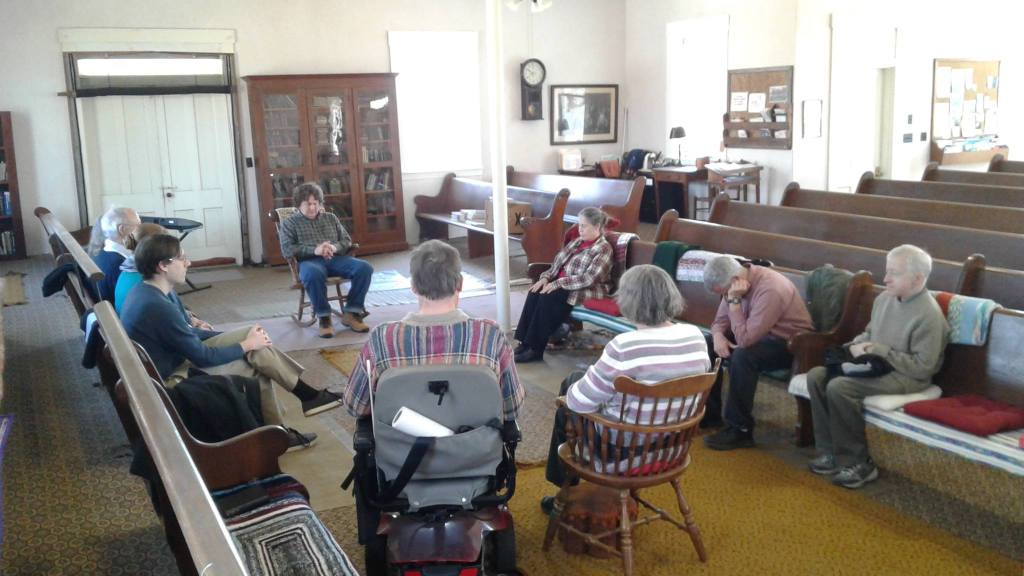
Our varied beliefs and practices didn’t matter. Our ages, our backgrounds, and even whether we were Friends at all weren’t important, either.
A blanket awaited everyone, sending a message of welcome, comfort, and love.
Just as God– The Great Comforter– soothes and comforts us all during bleak times, and in just the right ways that suit us best.

Leave a comment