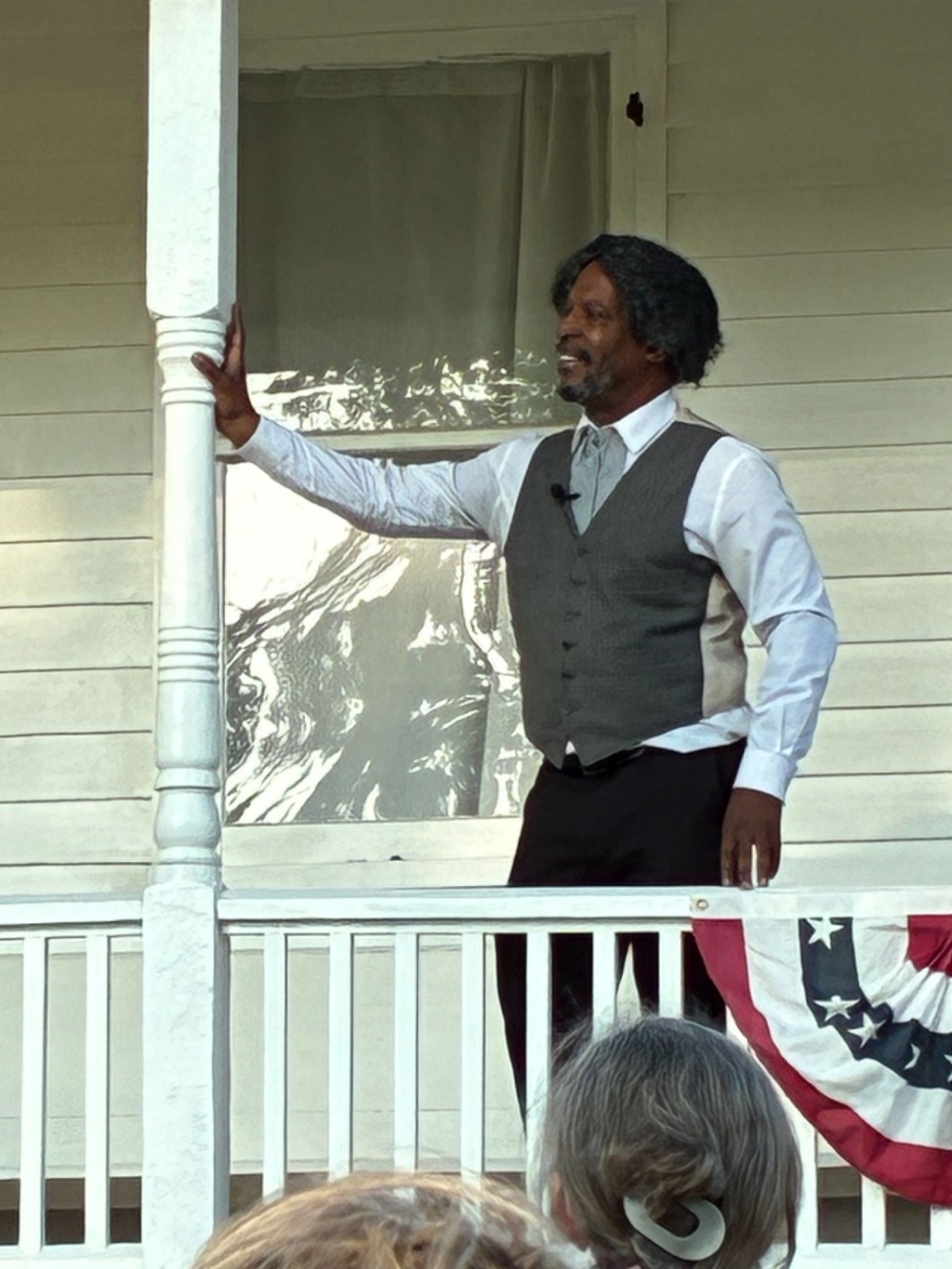
A week ago, I saw Frederick Douglass:
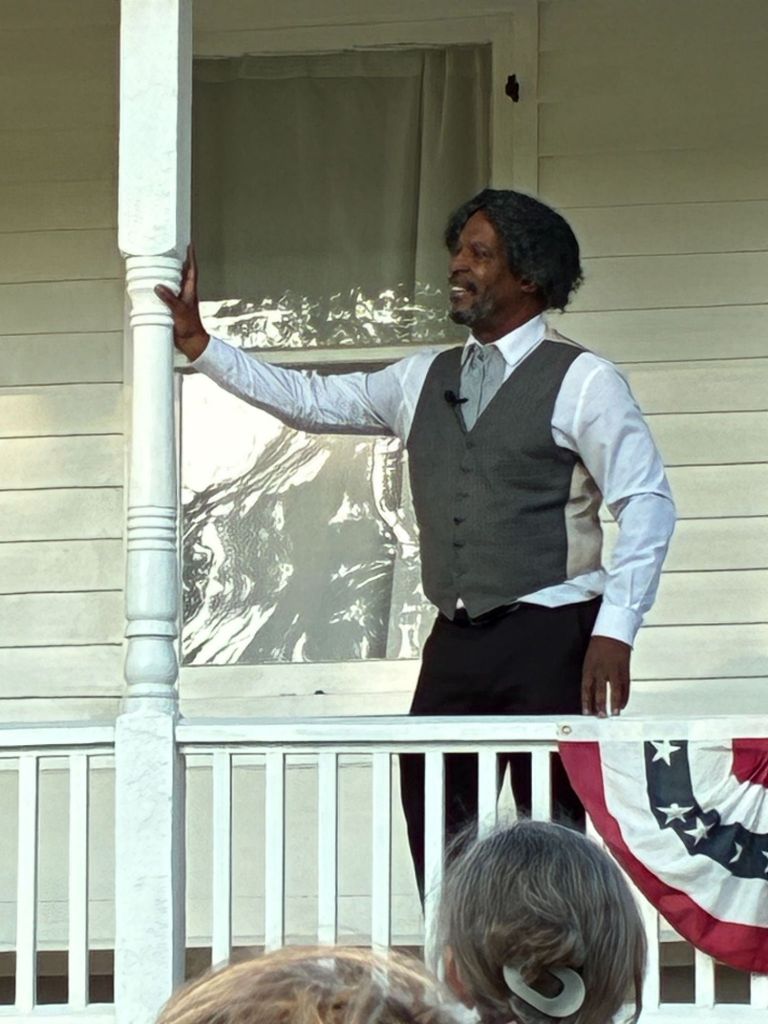
Well, not really.
But I did attend a performance by Darius Wallace, an actor of notable skill. In character as Douglass, Wallace delivered a one-man show at the Historic Fall Creek Meetinghouse, east of Pendleton, Indiana.
The outdoor venue perfectly framed the venue and the context: Douglass briefly recalled his harrowing 1843 visit to Pendleton, Indiana, where he was beaten up and taken to safety by members of the Fall Creek Meeting. The performance then went on to depict various scenes in Douglass’ remarkable life.
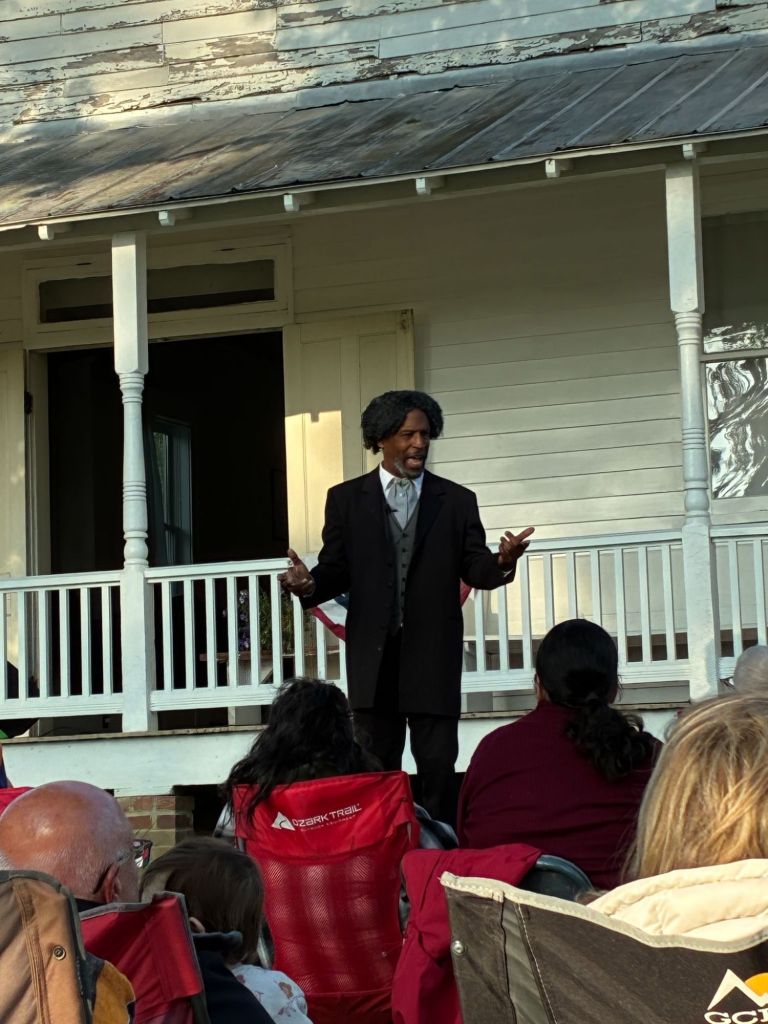
Wallace used the meetinghouse’s west porch as a stage. He bounded up and down the steps and venturer into the lawn chair-seated audience several times as he reenacted meaningful incidents in Douglass’ life and shared his views on abolition, human rights, and even women’s suffrage.
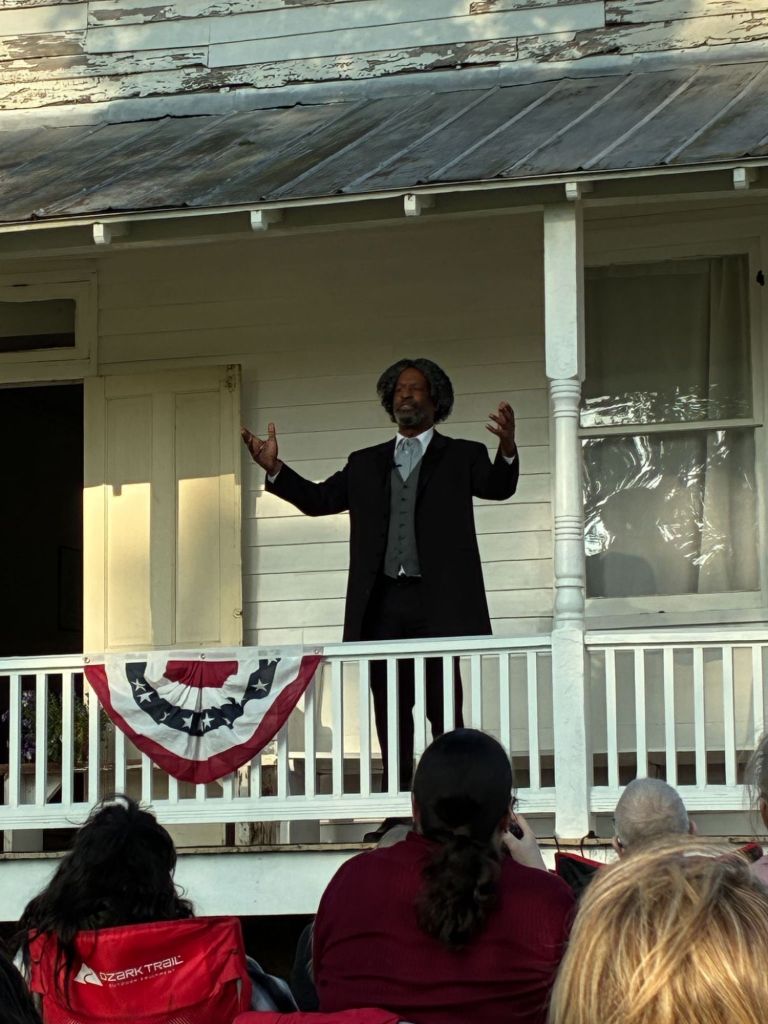
Wallace, an acclaimed actor with impressive television and stage credits, organized his performance chronologically throughout Douglass’ life, using his jacket, a rocking chair, and various voices to bring to life the formerly enslaved abolitionist as a child, as well as to depict his grandmother; fellow slave and mentor, William Lloyd Garrison; and even President Lincoln, among others.
Weaving the vignettes together was the golden thread of self-determination. Several times, Wallace referred to a story about an eaglet who had to decide whether he was a chicken or truly an eagle, capable of soaring high above the farmyard, despite being told otherwise.
As a former secondary American Literature teacher, I recognized several of the episodes depicted in Douglass’ life. Even though the verbiage is dated and the sentence structure is long and complex, excerpts from The Narrative of the Life of Frederick Douglass regularly made their way into my juniors’ Civil War unit.
But, as with all autobiographies, I was reminded that one must take the words of any writer explaining their own life- often years after crucial and formative events have taken place- with a somewhat critical eye.
Today, with the immediacy and drama of social media and fewer personal filters for airing “dirty laundry,” preserving family legacies and social standing seem less important than in decades past. Today, true autobiographies, which are chronological accounts from the writer’s birth through the publication date, are rare.
Instead, we see memoirs: These focus on harrowing or dramatic segments of the writer’s life, often in extreme situations. As a result of this change in format, the shorter and more focused lessons learned by the writer during discrete experiences have replaced long, drawn-out biographical tomes that present in equal detail both the fascinating and the ordinary times in a life.
And it’s no wonder.
Our culture of bullet-points and immediate gratification demands that we skip the boring sections. Get to the juicy parts!
Enter the salacious tendencies of memoir. And the wariness we should read them with as we accept the “writer’s truth” in storytelling.
Reading historical autobiographies should come with similar warnings. Writers choose the parts of their lives to include and exclude, as well as the tone, theme, and focus of each episode. Benjamin Franklin’s work- although almost tongue in cheek in parts- demonstrates the legacy-building mentality of influential personages like Old Ben.
Self-promotion is a legitimate concern in autobiographical writing.
Thus using a diary as a primary source when bringing historical characters to life can be so rewarding.
Why? By virtue of the simple fact that a diary is generally meant to be kept private.
Writing for oneself has, by definition, less rhetorical focus on audience and legacy than writing for others. Therefore, a “truer” version of the writer’s truth naturally emerges. At least, the writer’s truth in that moment– not one that’s been bleached and reshaped later for effective display and monetary compensation.
It’s true that diaries can be sluggish to wade through. This is particularly so if they are written more in the style of a journal, with factual accounts of daily events more prominently featured than the writer’s emotional responses to them. But even in dry summaries of each day, careful readers can infer personality traits and values from the writer by the topics that are included and the diction used to describe them.
The result is that diaries are a more intimate form of personal writing than autobiographies can ever be.
Typically never meant to be read by others, the diary confesses elements of the writer’s life that have not been vetted by a publisher or a legacy-focused author. Personal letters are a close second in usefulness, although many times they were meant to be read aloud to others and thereby include selective content, as my ancestor Mary Jane Edwards records in her diary when writing letters to folks back home.
As I watched Darius Wallace depict Frederick Douglass, I was reminded of how unusually blessed my family is to have our ancestor Mary Jane Edwards’ actual, physical 1866 diary. Based on the inscription in the front of the tiny leather-bound book, she faithfully kept it up to date to honor John and Eliza Watson, the Friends who presented it to her in Jackson, Mississippi.
Unlike a few other teachers of freedmen elsewhere, Mary Jane Edwards seemingly had no interest in publishing her daily entries or even sharing them with others. She recorded both the facts of the day and her occasional reactions to them. She noted her frustrations as she waited for schoolhouses to be built; as she tried to acclimate to the weather and resentful townspeople in the new “foreign land” of the former Confederacy.
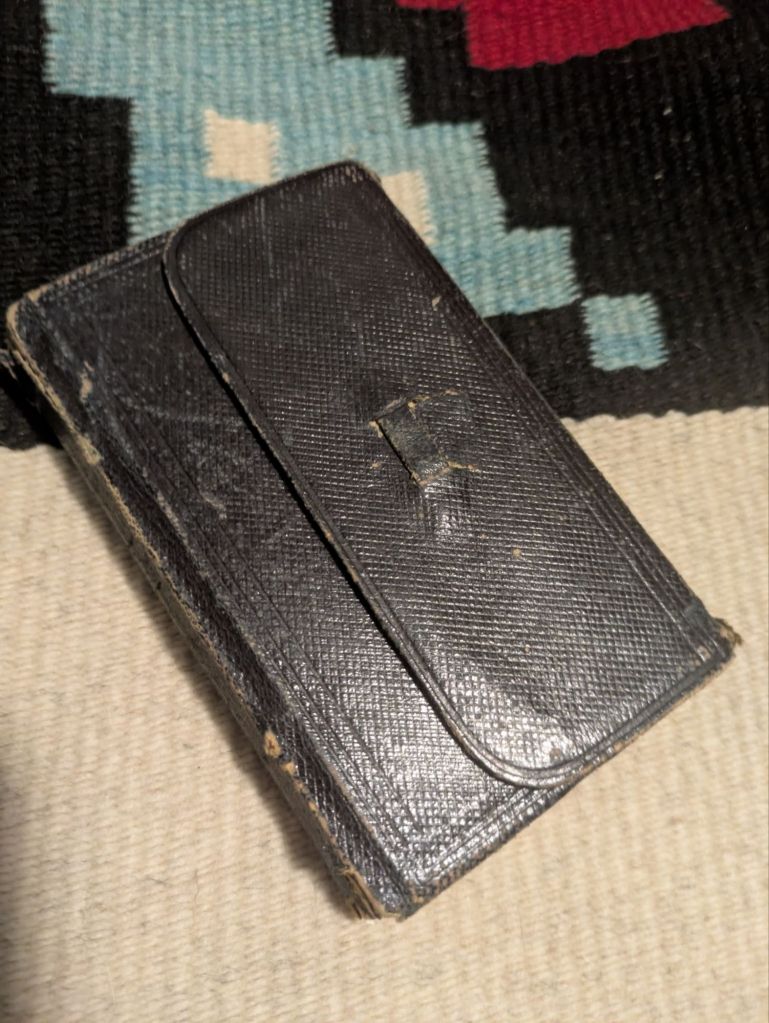
Sitting in my lawn chair, listening to Wallace’s Frederick Douglass orate, it struck me that much of Douglass’ writing was meant to be public. That was not true of Mary Jane.
She didn’t try to portray herself in a sympathetic light, as if anticipating and appealing to the reactions of readers. That suggests a fundamental honesty in both her character and her words- a quality which a commercially-published account might not preserve so faithfully.
For example, in February, while trying to maintain order in a class of 55 pupils, she mentions using the whip freely, even after sending one disruptive student home for the week.
Yes, she used a real whip for discipline in the classroom, in front of a classroom that contained other adults.
And she did it in spite of the Religious Society of Friends’ testimony of peace and nonviolence.
It’s a shocking admission, especially when read through our contemporary, judgmental glasses. And devoted Quaker Mary Jane would probably prefer that it not be made public.
But it was true.
Her daily accounts of teaching while in the South, and her work and worship back home during the summer, give a uniquely close-up, warts-and-all view of the values of a reasonably typical eldest daughter in a family of rural Hoosier Quakers during the Reconstruction Era.
The episode with the whip is, for better or for worse, one of the data points.
When we depict historical figures, including these kinds of frank admissions creates characters who feel more human, ones who are not always noble and upstanding and good. People we can relate to. People who are like all of us.
Frederick Douglass overcame incredible odds to become a brilliant abolitionist, social reformer, and statesman. This is easy to verify in the historical record. Although Wallace’s skilled and rousing interpretation left me feeling that I’d met Frederick Douglass, the great historical character, I still felt curious about Frederick Douglass, the real man. Surely he had human foibles and idiosyncrasies that tempered his greatness, or made it even more extraordinary.
In bringing historical characters to life, I suppose all we can do is to utilize the full breadth of information available to us – and hope that we get it right.
Hoping we get it right: I can relate to that.

Leave a comment