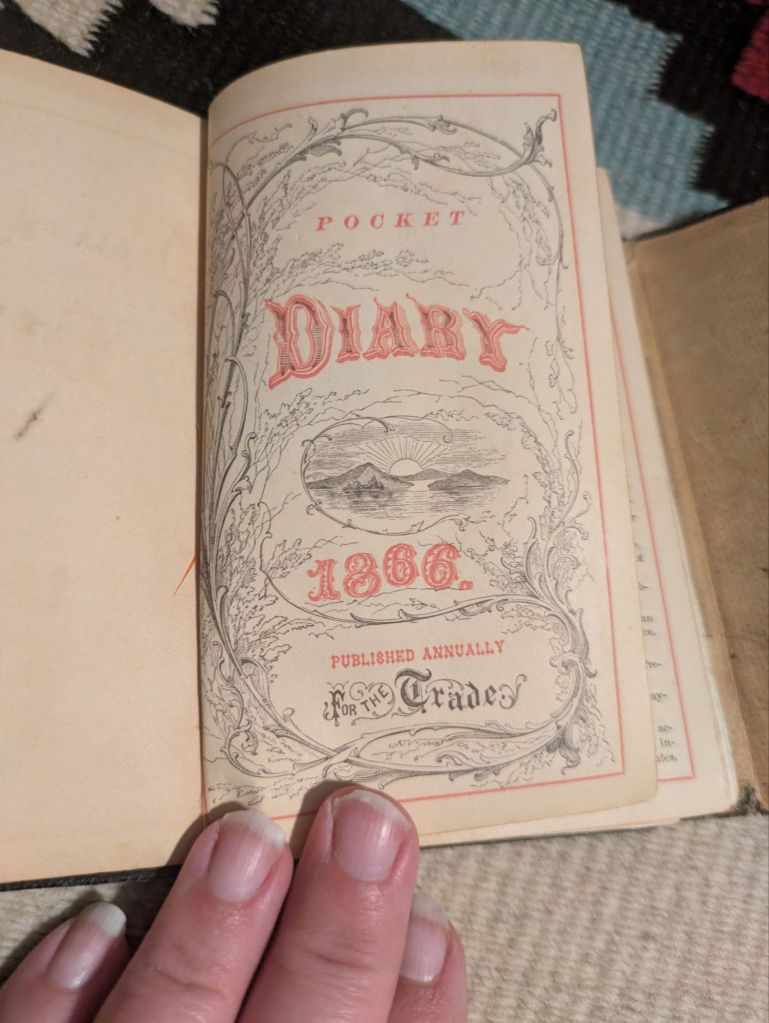
Sunday, May 27, 1866
Lizzie and I went to meeting to Elmgrove. Isaac Trueblood and his daughters Miriam & Mary were there. Meeting was small. In the afternoon Milton, Lizzie & Ella Hubbard went up to a spiritual meeting at Greensboro. The speaker was Mrs. Mitchell. They enjoyed it pretty well [and] stopped at Bales’s a little while as they came home. Melissa still has very poor health. It has been a little showery in the evening, turned very cool. I have not felt very joyous today. Although blessed with an abundance of blessings, like a child, I have been ready to call for more.
-Mary Jane Edwards
Even 169 years later, Mary Jane would recognize May in Indiana.
Today’s weather this morning as I write reflects exactly the rain and coolness of that Sunday in May when she wrote her diary entry.
Two topics from today’s entry continue to intrigue me each time I read it. One is the interest that my fourth great-grandmother Lizzie Edwards had in Spiritualism. The other is Mary Jane’s confession of selfishness.
Not surprisingly, Spiritualism took greater hold of many families during and after the Civil War. With thousands of sons, brothers, and husbands killed in battles far from home and many hastily buried in distant states, families lacked the funereal closure that could eventually give them comfort and peace about their deceased loved ones.
A twenty-minute drive southeast from my house on Indiana State Road 32 is a place renowned for Spiritualism, still operating today. Although Camp Chesterfield developed a generation later than MJ’s diary, its operations attest to the overwhelming comfort that communication with those who have passed over holds on their survivors.
Spiritualism, the belief that one’s spirit is a part of a being’s existence and that people can communicate with the spirits of the deceased, filled that gap for many families. The idea that bereaved families might be able to communicate through death’s veil with their loved ones who had passed on was incredibly attractive and reassuring.
But for Quakers? Really?
In fact, it seems some progressive Friends’ involvement with Spiritualism began much earlier. David Chapin writes that the notorious Fox Sisters’ first seances in 1848 included “evangelical Methodists, Quakers, and people prominent in moral reform…” (12). This interest began during the Second Great Awakening, a time which led to more societal interest in self-direction, abolition, and temperance (Chapin 12).
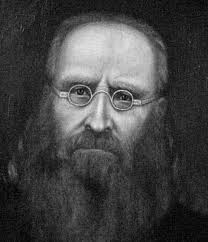
And it just so happens that Greensboro, Indiana, only about seven miles from the Edwards’ home, happened to be a center for early Spiritualism in Indiana. Greensboro resident Seth Hinshaw was well known in East Central Indiana for his store selling only slave-free goods, his abolitionist work, and his generous temperament, according to Judge Martin L. Bundy, who wrote a short biography of Hinshaw’s life.
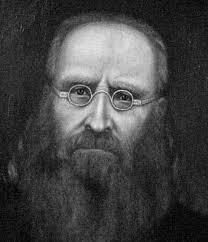
Indeed, Seth Hinshaw was involved in many causes, and perhaps was even a founder in the building of “Liberty Hall,” a gathering place for reformers’ meetings and conventions of the Free Soil and Liberty Party.
Hinshaw even hosted Frederick Douglass in his Greensboro home after the brutal incident that left Douglass wounded in Pendleton during his 1843 speaking tour. The next day, Douglass spoke at Liberty Hall.
By the 1840s, Friend Hinshaw had become a fervent supporter of the Spiritualist movement and a “convert to Spiritualism,” according to a biography of his Hinshaw’s life. “Progress Hall,” a new meeting hall in Greensboro for Progressive Spiritualists, also held claim to Hinshaw’s support.
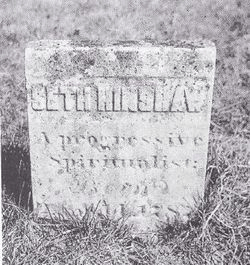
Seth Hinshaw died in November 1865, just five months before Mary Jane wrote this diary entry. No doubt his recent passing lent some mystique to the local Spiritualists’ gatherings.
But Mary Jane records that her younger sister Lizzie attended the Spiritualist meeting. She herself did not go.
I wonder why.
My research indicates that none of the Edwards brothers fought in the conflict, although they did register for the draft. Mary doesn’t mention any close friends being killed in the war, either.
But the family had known death. The sisters’ eldest sibling Anna/Hannah (Edwards) Hill died at age twenty-two in 1845, perhaps from after effects from delivering her only child Oliver who died six months later. Mary Jane was only fourteen when she became the eldest living daughter of William and Elizabeth Edwards with two older brothers.
Nine years later, the siblings’ father, William Edwards, died in 1855, eleven years before the sisters went South to teach. Mary Jane was twenty-three years old, and Lizzie twenty-one.
Did Lizzie still mourn them? Was she eager to contact them from the other side? Or was she just curious about this new, tantalizing topic?
And why wasn’t Mary Jane part of the progressive group of Friends that listened in rapt attention to speakers and mediums? Not all Quakers appreciated Hinshaw’s interest in Spiritualism.
I’ll never know; however, Lizzie’s interest in Spiritualism was too intriguing to ignore in the second novel based on Mary Jane’s diary. On the steamboat back to Indiana, I created a scene where the sisters encounter a couple intent on finding a medium to contact their son, a deceased soldier.
From this diary entry, I’m also intrigued by Mary Jane’s self-talk. Something seems to be missing in her life that is filled with abundance and blessings, as she herself admits. She compares herself to a child, wanting more.
Of course, most of us feel selfish and want more from time to time. That seems to be a human thought, if not emotion. But I wonder about Mary Jane’s mental health. Does she feel that she isn’t enough? Her diary is peppered with remarks about her inadequacies.
On her birthday, Friday, February 23, 1866, she wrote the following:
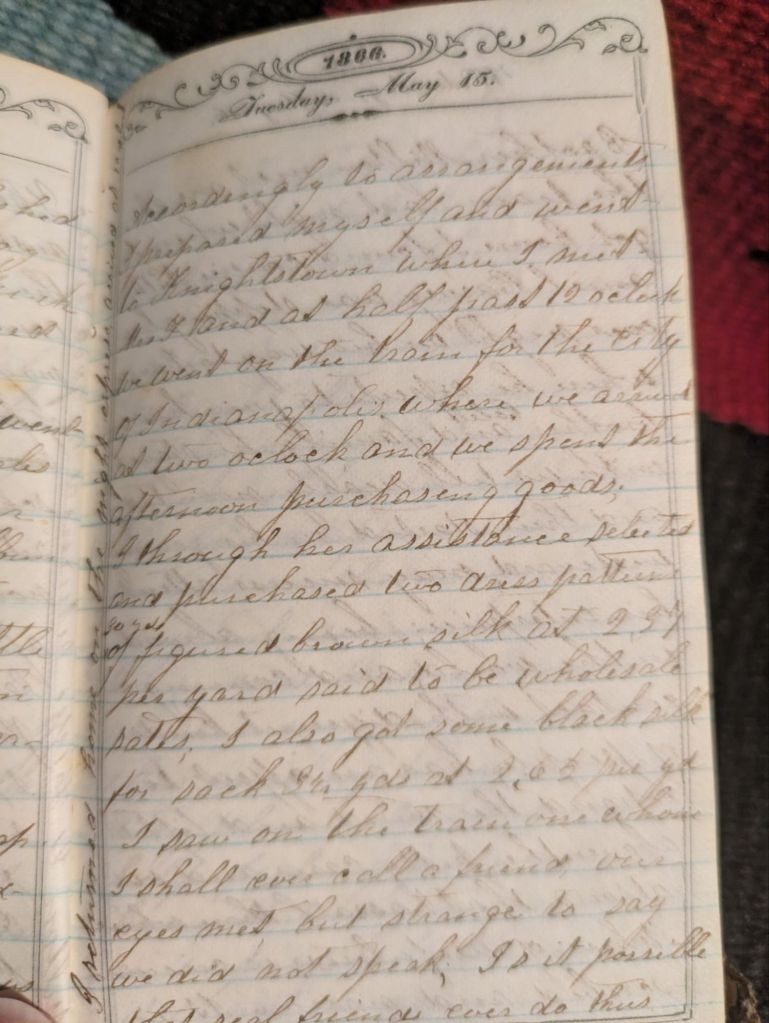
“I sometimes feel that I have lived in vain, that I have through weakness and incompetency, fallen far below the mark at which I have aimed.
“I have been beset much with darkness and disappointment but these I am convinced are a means of purification and refinement of the soul from the taunts of earth. Through all I have had a steadfast faith in the eventual triumph of truth and righteousness. I have been abundantly blessed, though very undeserving.”
Throughout the diary, her vivacious younger sister Lizzie goes horseback riding with new friends, attends parties with soldiers, and treks to Greensboro for temperance and Spiritualist events. And although Mary Jane gently chides her sister at times, she also defends her choices that seem less than Quakerly.
Is the mantle of the eldest daughter too much for Mary Jane at times? How hard is it for her to live up to the high expectations of her recorded minister mother and compete with the outgoing nature of her sister?
While having Mary Jane’s diary- written in 1866 and with a daily record of the events that the teachers encountered and daily life back home in Indiana- offers an incredible insight into the lives and minds of our ancestors, I can’t help but look at them with a contemporary lens.
I’ve created a Mary Jane who is strongly convicted, but holds herself to such a high standard that it is sometimes unattainable. The tension between what she believes she should be and what she often is creates self-judgment that can be hard to overcome.
Is that a Quaker thing?
Have I done her an injustice? Perhaps.
But I believe most of us can relate to regret at falling short of our ideals, at least once in a while.
CHAPIN, DAVID. “The Fox Sisters and the Performance of Mystery.” New York History, vol. 81, no. 2, 2000, pp. 157–88. JSTOR, http://www.jstor.org/stable/23182334. Accessed 27 May 2026.

Leave a comment