Any day now, it’ll be back to the classroom for several of my teacher friends.
But not for me! I’ve been retired for a few years now.
Even though I don’t miss teaching in a secondary English classroom, five things about this time of year still warm my heart:
1.) Catching a really good sale on school supplies
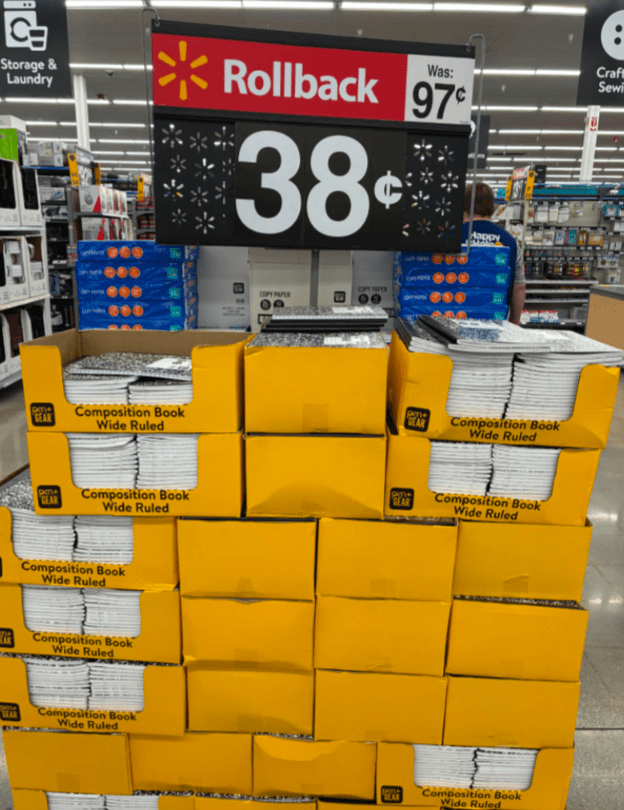
Last week, when I was at Walmart, I saw a display of composition books for 38 cents each. What a price! I had to take a snap and post it on my former professional organization’s Facebook page. Composition books make the best customizable writer’s notebooks!
High-quality composition books, boxes of Ticonderoga pencils, and Expo dry erase markers in unusual colors will always make me smile.

2.) Recruiting a willing helper to do the grunt work
Classroom heat and humidity are not kind to markers forced to weather the summer in a giant ziplock bag after being tossed into the cupboard at the end of the year!
More exciting first-day prep tasks propelled me, not the mundane ones like assembling pencil boxes for each group. Even so, colored pencils had to be sharpened, glue sticks and giant erasers unpackaged, and a full spectrum of markers tucked into plastic boxes to keep our classroom machine running. I was grateful for all who were willing to help before school began.
Early on, one of my own kids could be enticed to help with the promise of lunch out afterwards. For a few years, newly retired elementary teachers I knew were willing to give me an hour or two for nostalgia’s sake. Some years later, my granddaughter was excited to be at the high school and have free access to the hard candy tub as payment.
Now that I’m retired, I have to look a little harder for help with obnoxious chores! Luckily, though, my now-adult kids are usually still willing to help in exchange for dinner.
3.) Creating effective seating charts even before I met my students
What fun it was to look at the new names, recognize a few former students, and sort them into table groups. I used whatever data I had before for first-day seating: reading levels, test data, gender– never a lone female in a cluster, notes from previous teachers, IEP/504 needs, and previous grades.
In general-education classes, I learned to include one high flyer per group, next to a couple of middle flyers and a lower flyer, though never as an elbow buddy to the high performer. It was too frustrating for both. That way, someone at the table always understood and could help explain to the others if I was busy conferring with others.
As another benefit, all the students gained experience interacting with kids who learned differently or were experts in things outside of school.
In a high-ability class, I placed two top flyers in each group. Those students deserve to interact with someone at their level instead of just being expected to pull up the others.
But the more I learned about my students in the early days, the more we changed seats. In the years that students submitted summer assignments, my seating charts were awesome from Day One. After assigning the Myers-Briggs Personality Type Indicator assessments, interest inventories, and Multiple Intelligence trackers during the first week, I moved the kids again.
Soon, the groups began to take on personalities of their own. At least once a grading period, the groups were switched to help students learn to work with a variety of different people.
I pored over paper charts, with names always written in pencil and my own codes for IEP/504 needs. At some schools, students moved in and out regularly, resulting in constant seating-chart iterations. Later, with Powerschool photos available, remembering names became easier for me- and for our inevitable substitute teachers. Creating effective learning groups was a fun challenge in the before-school-starts days of meetings and more meetings.
As a recent widow, these days I have more to organize than ever.
4.) Creating eye-catching bulletin boards
When I first started teaching, I was shamed a bit by my peers for using bulletin boards in a high school classroom. “This is secondary,” I was told.
But I figured that most kids liked to look at something interesting, so keeping a current
bulletin board with engaging materials and student work became a priority.
Over the years, my student aides and I created several effective visuals. The giant mouse maze for Who Moved My Cheese?, a series of funny magazine pictures for “Our Pet Peeves,” and Mayan cartouches for our Pre-Columbian myth unit showed up year after year.
By the time I retired, my vertical file was immense. I was always scouting for interesting images or documents to display and pull students into the topic. I finally made four huge folders from corrugated cardboard to hold all my historical and inspirational posters, artifacts that could fold flat, and samples of excellent student work.
For years, I kept a model of an Elizabethan man in period clothing from a school Renaissance Faire and a Monopoly-style board game depicting Upton Sinclair’s The Jungle. I’m sure the custodians groaned when they had to remove my supplies to clean the room each summer.
Yes, I was sad to let them go when I retired.

5.) Students popping in to say hello
During the week or so before school started, new and former students often popped in to say hello while I was working. That was a treat! I appreciated knowing that former students still felt welcome in my classroom, and I appreciated the chance to quiz them about what their most helpful classroom activities had been. I also enjoyed meeting new students who might be anxious about my class or teaching style.
Toward the end of my teaching career, when I was in my room during freshman orientation day, a few of the new ninth-graders would pop in to introduce themselves. Sometimes, they’d turn out to be the younger siblings of kids I’d had in class before, but other times, they were just super-outgoing teens.
As the year began and progressed, it was fun to remember which students had taken the initiative to meet me before school actually began. In several instances, these same kids became my student aides and helped me with all kinds of project prep and classroom tasks.
I’m indebted to those student aides of mine! They stapled bulletin board materials, cleaned up paint and brushes, cut endless stacks of paper, assembled packets, hauled magazines and books, delivered materials, and supported me in the endless preparation that’s needed to teach well.
Overall, while I don’t pine for the classroom, I do fondly remember the people I met: those whom I hope developed better reading and writing and thinking skills on my watch, and certainly those individuals who helped me hone my craft and learn along the way.
After all, isn’t that what education is all about? Building relationships, learning, and growing- no matter when or where!
I’m sure those takeaways are what my ancestors, Lizzie and Mary Jane Edwards, brought back with them from Jackson, Mississippi, after teaching freedmen in 1866.
And so another successful school year begins!


Leave a comment