
As a recently retired secondary English teacher, I still get a little nostalgic for the first days of school. After getting my classroom ready and after a restless pre-first-day night, the excitement of getting acquainted with a new cohort of students propelled me through the first exhausting week of school.
I miss several parts of those first days of the school year: settling into a familiar routine, sharing my philosophy of education, and discovering how I could best teach my new students. Here are the five specific parts of that first week of classes that I wish I could still experience:
1.) The unexpected arrival of my personalized coffee order from my favorite Tiger Cafe workers
A most welcome jolt of energy after the long, restless night.
You know who you are!

2.) Shocked looks on students’ faces
Many of my new students had older siblings, who, in time-honored Blackhawk and Tiger tradition, were a little hyperbolic in warning their younger brothers and sisters about how tough my classes were. Some of the ninth graders who entered my classroom for the first time with a wide-eyed look of fear actually confessed with a sigh of relief on their way out, “That wasn’t so bad!”

3.) The Human Likert Scale
Even though it’s a theory from the 80s, I always enjoyed introducing the concept of how everyone is smart in different ways. One of my jobs, I told students, was to help them figure out how their unique ways of being smart could help them with school smarts- primarily math and language, the subjects on standardized tests.
Enter the Human Likert Scale tied to Multiple Intelligence Theory.

On Day One, a raucous group of volunteers from each block self-assessed their abilities in eight ways. For example, I would ask the group, “How well can you write an argumentative essay using three academic sources?” Of course, many students proudly rushed to the Expert end of the line, especially in the honors or AP classes.
But when asked questions about comforting a crying baby or taking apart an engine and putting it back together correctly, many of those academically bright students went woefully to the Novice side of the line.
What a joy to see the less academic kids puff up in pride at their own skills, and to see them look at their less academic peers with a note of surprise and admiration! We all enjoyed seeing how the line shifted again and again, noting that no one was at either end every single time.
MIT and the Human Likert Scale always built mutual respect for our learning community on the very first day.
And it set a baseline for some very different expectations and learning activities yet to come!
4.) Reading the interest inventories.
What! From this one little town, I have a student who is a musher? And a rodeo rider? I have five volleyball players who have gone to the state tournament? A pianist who travels around the world and gives concerts? A race car driver? A girl who fishes with a bow and arrow? A pilot? A computer programmer for a farm equipment company? Wow!
Every year, I used interest inventories during the first week of school to learn more about each student. It started with questions about hobbies, spare-time pursuits, and reading and writing habits. Then it evolved into a checklist with a few “Would You Rather”-type questions tossed in for fun. In later years, it became an online Google Form with a spreadsheet of results that made grouping students by interests or skills easy.

During the pandemic, the honors classes students created “Selfie” presentations about themselves using and identifying rhetorical devices- a sort of academic pretest and community-building activity. We shared them virtually as we built our groups and classes.
Small-group share and report time helped us begin building our learning community. Usually, on the second day of class, I pointed out that this was the only time in all our lives that our unique group of individuals would be together, so we needed to make the most of our opportunities to learn from each other.
I never used the “Four Corners” activity where students who have something in common gather in a corner. I wasn’t sharp enough to remember who gathered where for which question! Instead, I needed to read each student’s response and return to that data throughout the school year as we moved through our curriculum. Knowing my students allowed me to offer examples and coaching unique to each person when we met in reading or writing conferences.
I reveled in those days of getting to know new students and customizing impromptu mini-lessons for the class during lessons and for individuals in conferences.
5.) Customizing the writer’s notebook
The two days students spent decorating and customizing their writer’s notebooks were an investment that paid huge dividends. From classroom management, assessing individual temperaments, and seating placements to individual passions and watching students choose magazine images, then cut and paste them onto blank composition books, this simple activity was one of the best ways to get a sense of the class. Who could follow directions? Who was a leader? A follower? Who needed extra time to process? Who rushed just to be finished? Who pushed the limits?
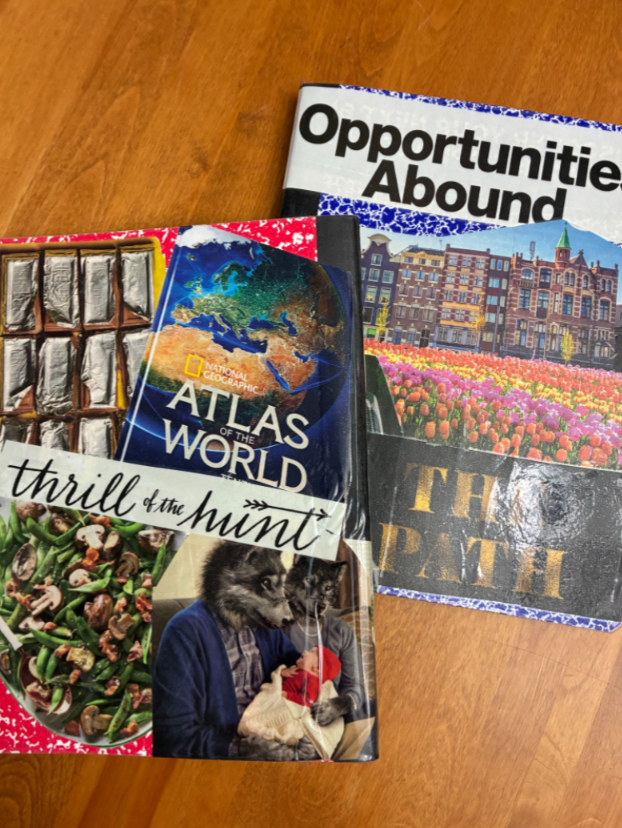
Best of all, when they were finished, most students were proud of their own individualized journals where they would write each day, copy important notes, and play with words.
Now, even though this is the fourth August that I haven’t been in a classroom, I still feel passionate about the first week of school. Shepherding a group of young people as they learned about language, thought and talked about life, and built new communication skills was such a joy. I miss that!
To all my teacher friends and former colleagues, to all teachers headed back to school, enjoy your first days with a new group of eager young people! You have the opportunity to make an impression that will last a lifetime- both yours and theirs!

Leave a comment