Sunday, September 23, 1866
Lizzie went to Spiceland meeting to bring Hannah Lymons to our house. She went to Uncle David’s for dinner, then to Jason Williams with H [and] L. Jason and his son Joseph are both sick; their recovery is quite doubtful. Mother went to meeting riding with Lizzie as far as S Gause’s. After meeting, Stephen Gause brought her and Rebecca Ballinger home. I went to the reading circle to [sic] late to hear the reading. William Harrison spoke some. John Byrkit was there and spoke. The singers failed.
Mary Jane Edwards
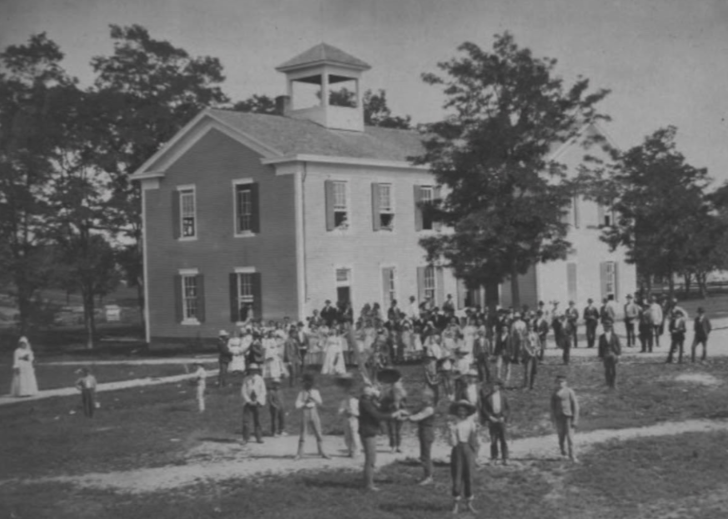
The Edwards family had strong ties to Spiceland, Indiana, with Mary Jane’s Uncle David Edwards and other relatives living nearby and members of the influential meeting. The siblings attended school there, and later they served in various capacities in the Spiceland Monthly Meeting. Family names like Williams, Newman, Harvey, Stanley, Holloway, Wickersham, Rayle, Painter, Hoffman, and others are part of my Quaker family heritage.
When the town of Spiceland celebrated its 100th birthday in 1938, noted historian Charles A. Beard wrote a letter of tribute to those commemorating the anniversary. Beard waxed nostalgically about his time spent in the little burg as a student at Spiceland Academy, which was officially chartered in 1878- only twelve years after Mary Jane wrote her diary entry. Even so, the old Spiceland school was already known for its excellence, having been established back in 1826. Indeed, Mary Jane writes about her brother Milton Edwards traveling between the Edwards’ farm and the school to take bookkeeping classes.
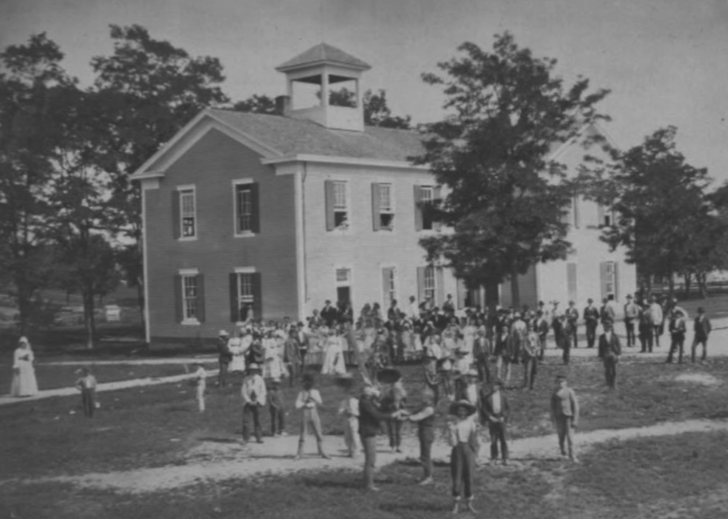
In an excerpt of Beard’s 1938 letter reprinted in the Indiana Magazine of History, the nationally known history and political science scholar writes about “debating societies” at the Academy. This provided readers an indication of the rigorous thinking and discussion that was promoted by the school:
The Academy had two debating societies and I was a member of one, the name of which I have forgotten. In the room set aside for us we had our own library of choice books, and there on Friday nights we assembled to solve the burning problems of the hour. Shall the tariff be reduced? Is fame to be preferred to great riches? Should the Federal government regulate railway rates? Local option or prohibition? With much eloquence and gusto the fledglings displayed their wisdom and learning (20).
Editor Clifton J. Phillips adds a footnote correcting Beard’s memory: “There were actually three literary societies at the Academy: the Lucernians, for girls, and two boys’ clubs, the Crescent and the Glisco” (20). With the Edwards siblings’ interest in literature and writing, I have no doubt that, as students, they would have eagerly participated in such groups.
Beard’s letter of recognition is also notable for his memories of being a child sitting in Quaker meeting and its value to him, having been raised in a non-Quaker home:
On First Day came Sabbath school and the meeting. Well I remember sitting on the hard benches, my feet far from the floor, while the elders sat in high places. No music. No song. Just the silence of meditation; unless, forsooth, the spirit moved some aged saint to deliver a discourse usually brief, always terse, generally ending in a quotation
from the Scriptures. Although my parents were not Quakers, they thought it good for me to attend the Friends’ services. Doubtless it was. At all events, there I became acquainted with the majestic dreams of the Jews, the merciful teachings of Jesus, and the sonorous roll of the King James version (20-21).
But not all was study, debate, and silent worship for the students of Beard’s generation. The male scholars had many diversions, including several outdoor sports and at least one very un-Quakerly skirmish:
Work and meditation were broken by play according to the season. Baseball, football, skating, sleighing, and sledding were my favorites. I remember especially what we called “the battle of the walnuts.” North of the Academy, across the road, beyond the graveyard, was a walnut grove, and after the autumn frosts fell the ground was covered with walnuts.
We boys made up teams, fitted shields made of barrel heads to our arms, arrayed ourselves in battle line, and let the walnuts fly. What heroic charges and frightful carnage! But nobody was hurt, although hands and faces were black with battle stains” (21).
Reading Beard’s recollections of Spiceland Academy helps me better appreciate the value and constancy of the Friends’ attitudes about education and worship. Beard’s memories and anecdotes of studies, sports, public speakers and fairs fill in the cracks of my understanding Spiceland Friends school culture in the late nineteenth century. WIth some imagination and envisioning a stricter attitude, it’s so much easier to imagine Mary Jane and her siblings attending school there just a generation or two earlier.
Phillips, C. J. (1959). Charles A. Beard’s Recollections of Henry County, Indiana. Indiana Magazine of History, 55(1), 17–23. http://www.jstor.org/stable/27788636

Leave a comment